
Most of us rarely think about balance until something changes. We hesitate before stepping off a curb, reach for a handrail more often, or find ourselves feeling less confident walking across uneven ground.
These seemingly small changes can gradually influence how we live, where we go, and which activities we feel comfortable doing.
Balance is not simply the ability to stand upright without falling. It is a remarkably sophisticated process involving the brain, nervous system, inner ear, eyes, muscles, and joints — all working together to keep us steady as we move through the world.
Although some of these systems become less efficient with age, declining balance is not necessarily an irreversible part of growing older. Many of the abilities that support stability remain responsive to training well into later life.
Understanding how balance works is an important first step toward preserving it.
Quick Summary
-
Balance depends on the coordinated interaction of several sensory and physical systems.
-
Age-related changes in proprioception, vision, muscle strength, and reaction time can affect stability.
-
Fear of falling can lead to reduced activity, further physical decline, and loss of confidence.
-
The brain retains the ability to learn and adapt throughout life.
-
Regular, appropriately challenging physical activity can help improve balance and reduce fall risk.
-
Recognizing changes in balance early can help protect mobility and independence.
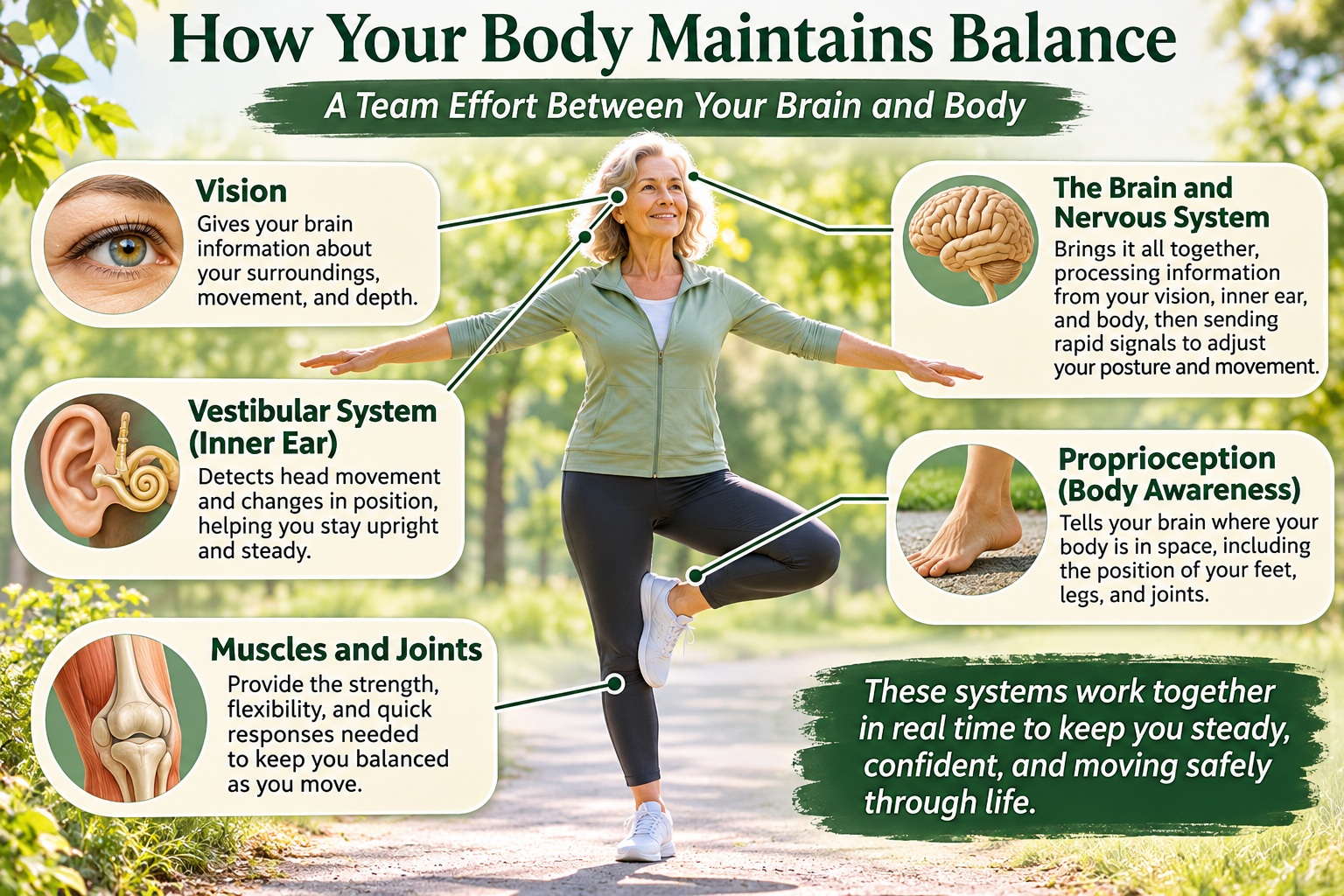
How Your Body Maintains Balance
Every time you walk, turn around, reach for something, or step over an obstacle, your brain performs a remarkable series of calculations.
Much of this happens automatically, without conscious thought.
To maintain balance, your brain continuously receives and integrates information from three major sensory systems.
Your Visual System
Your eyes provide information about your surroundings, including the position of objects, changes in ground level, and your movement relative to the environment.
Vision helps you anticipate obstacles and adjust your movements before encountering them.
This is one reason why walking in unfamiliar surroundings or poor lighting can become more challenging as we age.
Your Vestibular System
Located within the inner ear, the vestibular system detects head movements, acceleration, and changes in orientation relative to gravity.
It helps your brain distinguish between movement of your own body and movement in the surrounding environment.
It also contributes to keeping your vision stable while your head is moving.
When vestibular function is impaired, people may experience dizziness, disorientation, or unsteadiness.
Your Somatosensory System
Sensory receptors throughout your skin, muscles, tendons, and joints provide information about pressure, movement, and body position.
For example, receptors in the soles of your feet help detect changes in the surface beneath you, allowing your body to make subtle adjustments when walking across grass, sand, or uneven pavement.
Your brain combines information from these three systems and sends signals to your muscles to maintain or restore stability.
When one system becomes less reliable, the brain can often compensate by relying more heavily on the others. However, when several systems decline simultaneously, maintaining balance becomes more demanding.
What Is Proprioception — and Why Does It Matter?
Close your eyes and raise one arm above your head.
Even without seeing your arm, you know approximately where it is.
This ability is called proprioception — sometimes described as our body's sixth sense.
Proprioception allows us to sense the position and movement of our limbs without constantly looking at them. Specialized sensory receptors provide the nervous system with information about muscle length, tension, and joint movement.
This internal awareness helps us:
- Place our feet accurately when walking.
- Adjust our posture when reaching or bending.
- Navigate stairs without watching every movement.
- Respond to unexpected changes in the ground beneath us.
- Coordinate complex movements smoothly.
Research suggests that proprioceptive accuracy can decline with age, particularly in the lower limbs. This may make it more difficult to detect subtle changes in body position and respond quickly enough to maintain stability.
You may not notice these changes while standing on a firm, level surface. They often become more apparent when walking on uneven ground, changing direction, or moving in poorly lit environments.
Importantly, proprioception is not entirely fixed. Activities that challenge coordination, body awareness, and controlled movement can help train the sensory and motor systems involved in balance.
Why Balance Declines With Age
Balance rarely deteriorates because of a single physical change. More often, it reflects the gradual accumulation of changes across several systems.
Slower Sensory Processing and Reaction Times
Maintaining stability requires the nervous system to detect changes, process information, and activate the appropriate muscles.
With age, these responses can become slower.
Imagine unexpectedly stepping onto a loose stone. Your ability to recover depends not only on recognizing the instability but also on how quickly your body responds.
Even a small delay can make the difference between regaining your footing and falling.
Reduced Muscle Strength and Power
Muscle strength helps maintain posture, but muscle power — the ability to generate force quickly — is particularly important when recovering from a stumble.
Your muscles may be strong enough to perform everyday tasks but less capable of producing the rapid response needed when your balance is unexpectedly disturbed.
Changes in Vision and Inner Ear Function
Age-related changes in depth perception, contrast sensitivity, and vestibular function can make it more difficult to interpret movement and navigate complex environments.
Walking down steps, moving through crowded spaces, or transitioning from bright sunlight into a dimly lit room may require greater concentration.
As we age, our pupils tend to become smaller, the natural lens of the eye becomes less transparent, and the retina may become less efficient at processing light in dim conditions. Our eyes may also take longer to adjust when moving from bright to dark environments.
Although prescription glasses can correct many common focusing problems, they cannot fully compensate for all of these age-related physiological changes. Even people with excellent corrected daytime vision may experience difficulties seeing clearly in poor lighting.
Progressive and bifocal lenses may also make it more difficult for some people to judge steps and obstacles accurately when looking downward.
Regular eye examinations, appropriate prescription lenses, and adequate lighting can therefore play an important role in maintaining stability and reducing fall risk.
Reduced Variety of Movement
Modern lifestyles do not always provide sufficient opportunities to challenge our balance.
We may spend much of our day sitting, walking on predictable surfaces, and performing familiar movements.
Over time, reduced exposure to activities that require coordination, changes in direction, and controlled weight transfer may contribute to declining balance skills.
The Connection Between Muscle Strength and Balance
Good balance requires more than strong legs. It depends on several muscle groups working together efficiently.
The muscles around the ankles make small, continuous adjustments that help keep us upright. The hips and core contribute to stability when we shift our weight, while the larger muscles of the legs help us recover when our balance is disrupted.
The feet also play an important role. They provide both mechanical support and sensory feedback about the surfaces beneath us.
Muscle strength provides the physical capacity to respond, while coordination and proprioception help determine when and how that response occurs.
This is why strength training and balance training complement one another rather than being interchangeable.
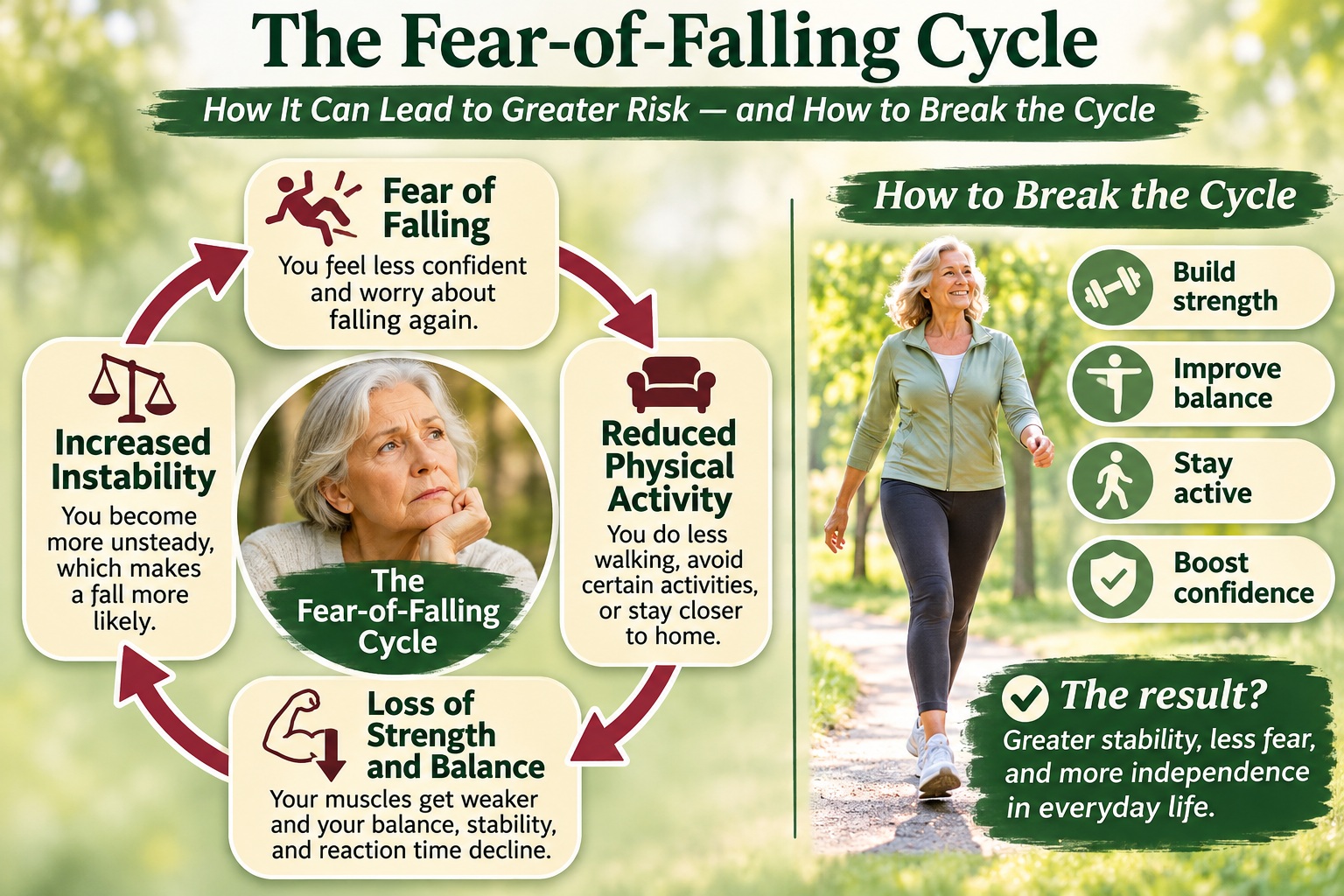
Why Fear of Falling Can Make Balance Worse
One of the less obvious threats to maintaining independence is the fear of losing it.
After experiencing a fall or a frightening moment of instability, people often become more cautious. This is understandable, and appropriate caution can be protective.
However, excessive fear can gradually restrict everyday activities.
The Fear-of-Falling Cycle
Fear-driven avoidance can reinforce the very physical limitations a person is trying to prevent.
Someone who once enjoyed walking outdoors may begin staying at home. Others may avoid stairs, social outings, or unfamiliar environments.
As activity decreases, physical conditioning and confidence can deteriorate further.
Research suggests that appropriately structured exercise can help reduce fear of falling, although results vary and continued participation may be needed to maintain improvements.
Breaking this cycle involves rebuilding physical capacity and confidence gradually, within a safe and supportive environment.
Can You Regain Lost Balance?
One of the most encouraging discoveries in neuroscience is that the brain retains the ability to adapt throughout life.
This capacity is known as neuroplasticity.
When we practice a movement repeatedly, the nervous system can refine how it processes sensory information and coordinates muscular responses.
Learning a new dance sequence, practicing controlled weight transfers, or participating in Tai Chi can challenge these abilities in different ways.
Older adults may require more time and repetition to master unfamiliar movements, but meaningful improvements remain possible.
Effective balance training generally involves activities that are sufficiently challenging to stimulate adaptation while remaining appropriate for the individual's physical abilities.
The objective is not to eliminate every age-related change. It is to improve the body's ability to function effectively despite those changes.
What the Research Tells Us
A major 2019 Cochrane systematic review examined 108 randomized controlled trials involving more than 23,000 older adults across 25 countries.
Cochrane is an independent, international organization recognized for its rigorous evaluation of healthcare research. Rather than relying on the findings of a single study, a systematic review examines the collective evidence from multiple studies, assesses their quality, and evaluates how confidently conclusions can be drawn.
This approach helps researchers determine whether the benefits observed in individual studies are supported by the broader scientific evidence.
The researchers found that:
- Exercise programs reduced the overall rate of falls by 23%.
- Balance and functional exercises reduced the rate of falls by 24%.
- Programs combining different types of exercise, typically including balance and resistance training, probably reduced the rate of falls by 34%.
These findings demonstrate that falling is not simply an unavoidable consequence of growing older. Targeted physical activity can make a meaningful difference.
Understanding how balance works is an important first step, but putting that knowledge into practice is what helps us maintain and improve our physical abilities. In our companion article, Better Balance After 60: Practical Exercises to Reduce Your Risk of Falling, we explore practical exercises, effective training strategies, and everyday habits that can help you develop greater stability and confidence.
Recognizing the Early Warning Signs
Changes in balance often develop gradually and can be easy to overlook.
Some early signs include:
- Increasing reliance on handrails or furniture for support.
- Difficulty changing direction while walking.
- Feeling less confident on uneven surfaces.
- Becoming noticeably unsteady in poor lighting.
- Experiencing more frequent trips, stumbles, or near-falls.
- Finding it harder to step over obstacles.
These changes deserve attention rather than being automatically dismissed as normal aging.
Balance difficulties can also arise from medication side effects, low blood pressure, inner ear disorders, impaired vision, or neurological conditions.
If you experience persistent dizziness, unexplained unsteadiness, or repeated falls, seek professional assessment before attempting challenging balance exercises. Sudden, severe balance difficulties, especially when accompanied by weakness, speech disturbances, or vision changes, require emergency medical attention.
Identifying the underlying cause can help determine which interventions are most appropriate.
The Bottom Line
Balance is not simply about preventing falls. It is about preserving the freedom to move confidently through everyday life.
The ability to walk outdoors, explore new places, climb stairs, garden, travel, and participate in social activities all contributes to a sense of independence and well-being.
While aging can influence the systems responsible for balance, it does not mean we must passively accept every decline.
By maintaining muscle strength, regularly challenging our coordination in safe ways, and addressing changes in stability early, we can help preserve the physical abilities that allow us to remain active and engaged.
Balance deserves the same attention as muscle strength, bone health, and cardiovascular fitness.
The goal is not simply to avoid falling — it is to keep living confidently.
Medical Disclaimer: This article is provided for educational and informational purposes only and is not intended to replace professional medical advice, diagnosis, or treatment. Always consult a qualified healthcare professional regarding concerns about balance, dizziness, falls, or underlying medical conditions, and before beginning a new exercise program, particularly if you have existing health conditions or mobility limitations.
Frequently Asked Questions
At what age does balance start to decline?
There is no universal age at which balance begins to deteriorate. Gradual changes can emerge during middle age and become more noticeable after 60. Physical activity, sensory health, medical conditions, and individual differences all influence the rate of decline.
Can balance improve after the age of 70 or 80?
Yes. Older adults can improve aspects of balance, coordination, and functional mobility through appropriately structured training. The extent of improvement depends on individual health, underlying causes, and consistency of practice.
Is walking enough to maintain good balance?
Walking supports mobility, endurance, and general physical health. However, ordinary walking may not sufficiently challenge every aspect of balance. Including dedicated balance and functional exercises can provide additional benefits.
Why is my balance worse in the dark?
Your brain uses visual information to help maintain stability. When that information becomes less available, it must rely more heavily on proprioception and the vestibular system. Deterioration in these systems can make navigating poorly lit environments more difficult.
Does having strong muscles mean I have good balance?
Not necessarily. Muscle strength provides the physical capacity to maintain posture and recover from instability, but balance also requires sensory awareness, coordination, and timely muscular responses. Training both strength and balance is beneficial.
References
Balance and Gait in the Elderly: A Contemporary Review
Journal of the American Academy of Orthopaedic Surgeons, 2019.
Examines age-related changes in sensory function, walking patterns, and postural stability.
Goble DJ et al. Neuroscience & Biobehavioral Reviews, 2009.
Explores age-related changes in proprioception, their functional consequences, and the potential for adaptation.
Exercise for Preventing Falls in Older People Living in the Community
Sherrington C et al. Cochrane Database of Systematic Reviews, 2019.
A comprehensive systematic review evaluating the effectiveness of exercise interventions in preventing falls among older adults.
Physical Therapy, 2022.
Examines the effectiveness of exercise interventions in reducing fear of falling among community-dwelling older adults.
Balance Disorders — Causes, Types and Treatment
National Institute on Deafness and Other Communication Disorders (NIDCD).
Explains the biological systems responsible for balance, common balance disorders, symptoms, and potential causes.
Continue Learning
Explore more ways to protect your strength, mobility, and independence as you age.