
Good balance is not something we simply possess or lose. It is a physical skill that can be developed, maintained, and, in many circumstances, improved.
Yet while many people recognize the importance of walking and strengthening their muscles as they age, relatively few devote time specifically to training their balance.
Think about the movements you perform throughout an ordinary day. You step sideways to avoid someone in a supermarket, reach into a cupboard, turn around in the kitchen, or stand on one leg while putting on your pants.
Each of these activities requires a degree of stability, coordination, and muscular control.
Developing better balance is not about mastering impressive physical feats. It is about preparing your body to meet the everyday challenges that allow you to remain active, confident, and independent.
In our companion article, Staying Steady After 60: How to Improve Balance and Protect Your Independence, we explore the remarkable biological systems responsible for balance and why many of these abilities remain trainable as we age.
Here, we turn that understanding into practical action.
Quick Summary
-
Balance training can improve stability, coordination, and functional mobility well into later life.
-
Effective training involves appropriate challenge, consistency, variety, and gradual progression.
-
Both stationary and moving balance exercises are important.
-
Strong, mobile feet and ankles provide an important foundation for stability.
-
Tai Chi combines several valuable components of balance training.
-
Short, manageable exercise sessions can provide a starting point for developing a regular routine.
What Makes Balance Training Effective?
Balance training works by challenging the nervous system to coordinate movement and maintain stability under different conditions.
However, simply repeating movements that you already find easy may not provide enough stimulation to produce continued improvement.
Four important principles underpin effective balance training.
Appropriate Challenge
An exercise should require some concentration and muscular effort without placing you at unnecessary risk.
For example, standing with your feet close together may initially feel challenging. As your stability improves, you may be able to perform the same exercise with lighter hand support.
The aim is controlled difficulty, not instability for its own sake.
Consistency
Balance is a skill, and skills generally improve through regular practice.
The World Health Organization recommends that adults aged 65 and older participate in varied multicomponent physical activity emphasizing functional balance and strength training at moderate or greater intensity on three or more days each week.
Regular practice provides repeated opportunities for the nervous system to refine its responses.
Gradual Progression
As your abilities improve, exercises can become slightly more demanding.
Progression might involve:
-
Maintaining a position for a little longer.
-
Increasing the number of controlled repetitions.
-
Introducing different directions of movement.
-
Reducing reliance on hand support when safe.
Change one element at a time. There is no benefit in progressing faster than your body can safely accommodate.
Variety
Everyday life rarely requires us to remain perfectly still. We turn, reach, bend, step sideways, and transfer our weight from one leg to another.
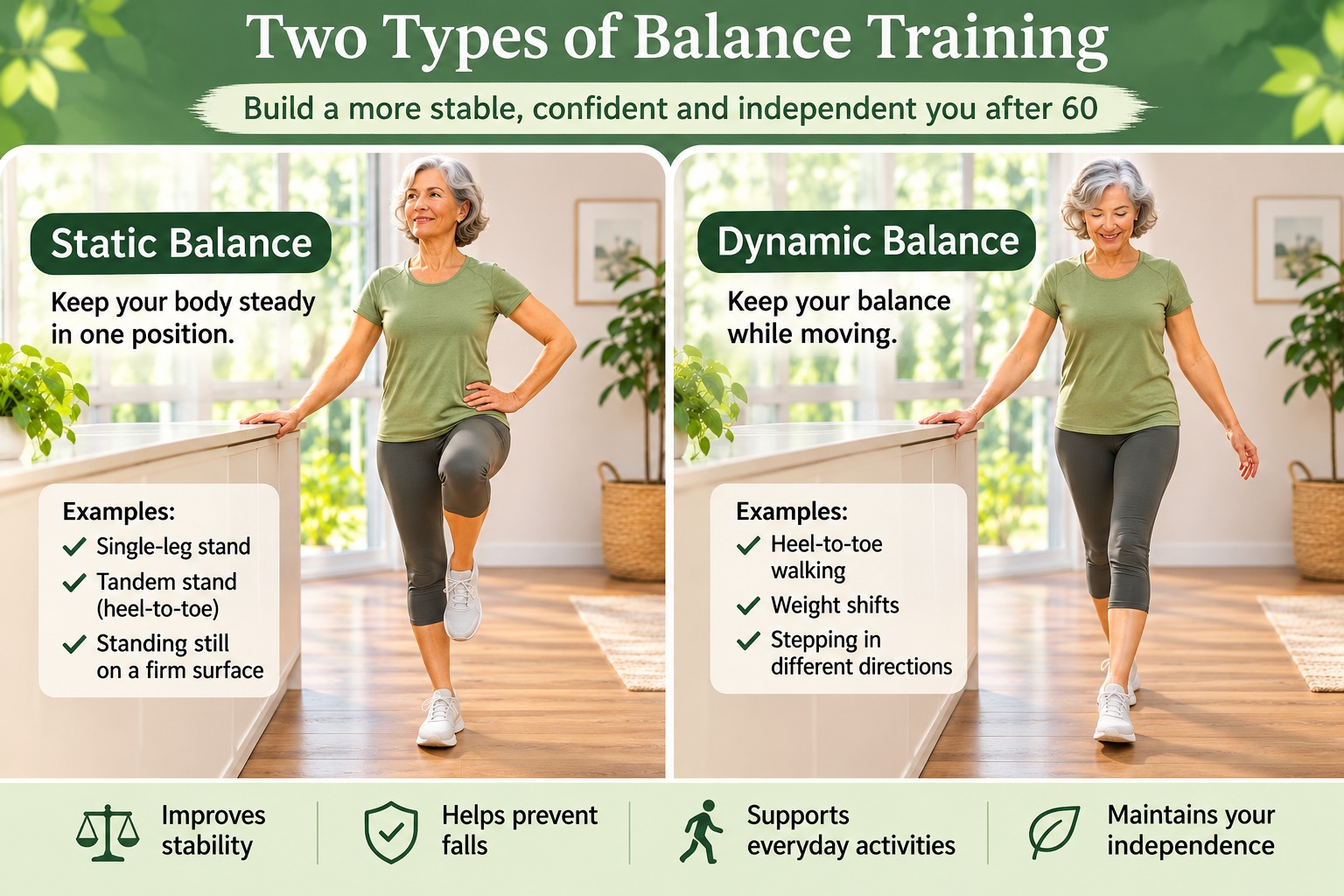
An effective balance program should therefore develop both:
Static balance: The ability to maintain stability while stationary.
Dynamic balance: The ability to maintain stability while moving.
Both contribute to our ability to perform everyday activities confidently.
How to Assess Your Balance Safely
Before beginning a balance program, it can be useful to become more aware of your current abilities.
Stand beside a sturdy kitchen counter or securely fixed support, keeping your eyes open and wearing appropriate footwear.
Begin with your feet comfortably apart. If this feels secure, try bringing your feet closer together.
You might then position one foot slightly ahead of the other, creating a narrower base of support.
Notice whether you need to grip the counter firmly, experience excessive swaying, feel considerably less stable on one side, or become anxious when changing your foot position.
These observations can help you identify an appropriate starting point. They are not, however, a diagnostic assessment or a reliable way to determine your individual fall risk.
If you have experienced repeated falls, persistent dizziness, significant unsteadiness, or difficulty standing without support, seek professional assessment before beginning independent balance training.
A physical therapist can assess your mobility and develop a program suited to your individual needs.
Five Exercises to Improve Your Balance
The following exercises introduce several important components of balance, including postural control, weight transfer, coordination, and multidirectional movement.
Begin beside a sturdy support, on a firm, nonslip surface. Keep your eyes open and use as much hand support as necessary.
The suggested durations and repetitions are starting examples rather than universal prescriptions.
1. Supported Single-Leg Stand
Standing on one leg challenges your ability to maintain stability over a smaller base of support.
This skill is particularly relevant to walking because every step involves a brief period during which your weight is supported by one leg.
How to perform it:
- Stand upright beside a sturdy counter.
- Hold the counter securely.
- Transfer your weight onto one leg.
- Lift your other foot slightly off the floor.
- Hold for five to ten seconds, if comfortable.
- Lower your foot and repeat on the other side.
Begin with two or three repetitions on each side.
What it develops: Single-leg stability, hip and ankle control, and postural coordination.
2. Tandem Standing
Tandem standing involves positioning one foot directly in front of the other, reducing the width of your base of support.
This encourages your body to make small, coordinated adjustments to remain upright.
How to perform it:
- Stand beside a sturdy counter.
- Place one foot slightly ahead of the other.
- If comfortable, gradually move toward a heel-to-toe position.
- Maintain an upright posture and look ahead.
- Hold for ten to twenty seconds, using hand support.
- Change which foot is in front.
What it develops: Postural control, ankle stability, and coordination.
3. Heel-to-Toe Walking
This exercise introduces movement while maintaining a relatively narrow base of support.
It is more challenging than ordinary walking and should only be attempted when supported tandem standing feels manageable.
How to perform it:
- Stand alongside a long, sturdy counter.
- Take a small step forward, placing your heel close to the toes of your other foot.
- Continue slowly for several steps, maintaining hand support.
- Pause and return to a comfortable standing position.
There is no need to achieve a perfect heel-to-toe position initially.
What it develops: Dynamic balance, precise foot placement, and movement coordination.
4. Controlled Weight Shifts
The ability to transfer your body weight smoothly is fundamental to walking, turning, reaching, and changing direction.
How to perform it:
- Stand with your feet approximately hip-width apart, holding a sturdy counter.
- Slowly shift your weight toward your right leg without lifting your feet.
- Return to the center.
- Shift your weight toward your left leg.
- Repeat five to ten times on each side, as comfortable.
Keep your movements slow and controlled.
What it develops: Weight transfer, body awareness, and control of your center of mass.
5. Multidirectional Stepping
Everyday movement involves more than walking forward. Being able to step sideways and change direction confidently is an important component of functional mobility.
How to perform it:
- Stand facing a sturdy counter with sufficient clear space around you.
- Take a small step to one side.
- Return to your starting position.
- Repeat in the opposite direction.
- When comfortable, introduce small forward and backward steps, provided secure hand support remains within easy reach.
Begin with a few repetitions in each direction.
What it develops: Dynamic stability, directional control, and coordination.
If any exercise causes dizziness, pain, or a feeling that you may fall, stop. Exercises that are too challenging should be modified rather than forced.
Strengthening Your Feet and Ankles
When we think about improving balance, we tend to focus on the larger muscles of the legs and core. However, some of the most important work takes place much closer to the ground.
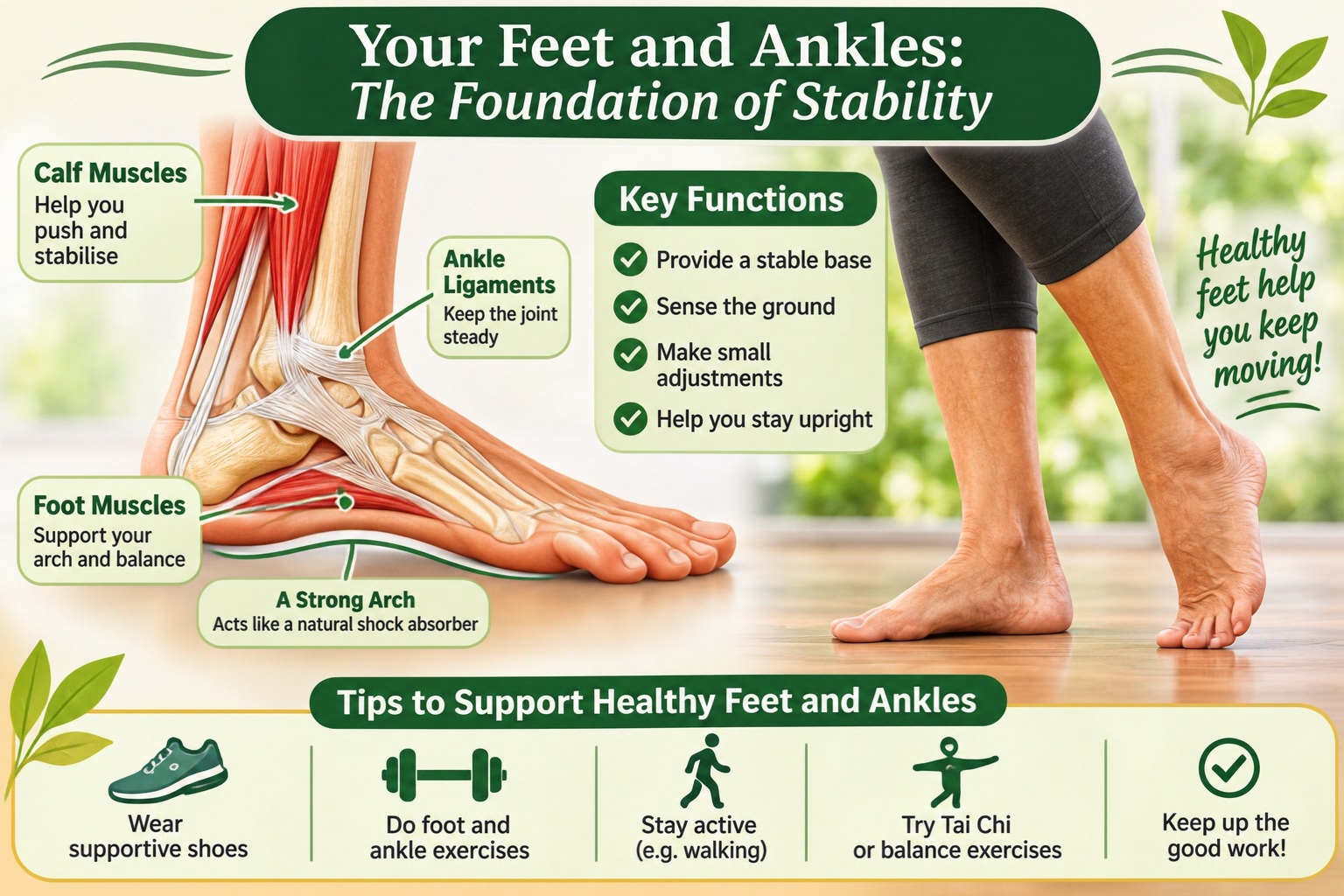
Your feet are your body's primary point of contact with the surface beneath you.
The small muscles within your feet help support their structure, while sensory receptors provide continuous information about pressure and changes in the ground.
The muscles surrounding your ankles make subtle adjustments to help maintain stability.
The Ankle Strategy
When you are standing upright and experience a small disturbance to your balance, your body often responds by adjusting muscle activity around the ankles.
This is known as the ankle strategy.
Larger disturbances may require movements at the hips or a rapid step to prevent a fall.
Reduced ankle mobility and muscle weakness can limit the effectiveness of these responses.
Three relatively simple exercises can help develop foot and ankle function.
Supported heel raises: Hold a sturdy counter and slowly rise onto the balls of your feet before lowering your heels. Begin with five to ten repetitions.
Seated toe raises: Sit with your feet flat on the floor. Keeping your heels grounded, lift the front of your feet and toes before slowly lowering them.
Seated ankle circles: Lift one foot slightly off the floor and gently rotate your ankle in both directions within a comfortable range of motion.
These exercises complement dedicated balance training, although they should not be considered a complete fall-prevention program.
Maintaining strength throughout the rest of the body is equally important. Our article Why Muscle Strength Matters More as You Age — and How to Preserve It explores the broader relationship between muscle function and physical independence.
Tai Chi and the Science of Balance
Tai Chi is a traditional Chinese practice characterized by coordinated movements, controlled breathing, and deliberate transfers of body weight.
What makes Tai Chi particularly interesting from a healthy aging perspective is that it brings several components of balance together within a single activity.
These include controlled weight transfer, postural awareness, coordination between the upper and lower body, adjustment of foot position, and controlled changes in direction.
Unlike many conventional exercises, Tai Chi encourages continuous awareness of how the body moves through space.
What Does the Research Show?
A major 2019 Cochrane systematic review examined the effectiveness of exercise in preventing falls among older adults.
The researchers found that Tai Chi may reduce the overall rate of falls by approximately 19%. They also found more certain evidence that Tai Chi reduced the proportion of older adults experiencing a fall.
The benefits may vary depending on the style of Tai Chi, the program's duration, the quality of instruction, and the physical capabilities of participants.
For beginners, a class specifically designed for older adults can provide an accessible introduction.
Tai Chi does not require advanced flexibility or athletic ability. Movements can often be adapted to accommodate different levels of mobility.
Building Balance Training Into Your Daily Routine
One of the biggest obstacles to maintaining a regular exercise routine is finding the time and motivation to do it.
Balance training has a practical advantage: it can often be incorporated into activities you already perform.
For example, while waiting for your morning coffee to brew, you could spend a minute practicing supported weight shifts or heel raises beside the kitchen counter.
Rather than viewing balance training as another demanding obligation, consider it an opportunity to develop a useful physical skill throughout your week.
Start With a Manageable Routine
The following is an example of a short beginner session for someone who can safely perform the supported exercises described earlier.
An example of a short beginner session
| Exercise | Suggested Time |
|---|---|
| Controlled weight shifts | 1–2 minutes |
| Supported single-leg stands | 1–2 minutes |
| Tandem standing | 1–2 minutes |
| Heel-to-toe walking | 1–2 minutes |
| Multidirectional stepping | 1–2 minutes |
| Supported heel raises | 1–2 minutes |
| Total | 6–12 minutes |
Rest whenever necessary and omit or modify exercises that exceed your current capabilities.
A short session like this can provide a manageable introduction to balance training. It is a starting point rather than a complete, clinically validated fall-prevention program.
As your capabilities improve, you may benefit from longer sessions, additional exercises, or professional guidance.
Recognizing Your Progress
Improvements in balance may initially be subtle.
Rather than focusing exclusively on how long you can stand on one leg, pay attention to changes in your everyday capabilities.
Changing direction may feel easier. You may rely less heavily on support during familiar exercises, find that your movements feel smoother, or become more comfortable transferring your weight from one leg to another.
These improvements may be more meaningful to your quality of life than achieving a particular exercise target.
However, maintaining stability during controlled exercises is only one dimension of balance. Everyday life also requires us to respond to unexpected obstacles, distractions, and changes in our surroundings.
We explore these fascinating aspects of balance in our companion article, Beyond Balance: How to Stay Steady and Safe in Everyday Life After 60.
The Bottom Line
Balance is a physical skill that deserves regular attention, just like muscle strength and cardiovascular fitness.
Through appropriately challenging exercises, consistent practice, and gradual progression, many older adults can improve their stability and coordination.
You do not need expensive equipment or complicated routines to begin developing these abilities.
Start with what you can safely manage and gradually build upon your capabilities.
The goal is not to become exceptionally good at balance exercises. It is to become more capable and confident in everyday life.
Medical Disclaimer: This article is provided for educational and informational purposes only and is not intended to replace professional medical advice, diagnosis, or treatment. Consult a qualified healthcare professional before beginning a new exercise program, particularly if you have existing health conditions or balance difficulties. Always perform exercises in a safe environment with appropriate support.
Frequently Asked Questions
How often should I practice balance exercises?
International physical activity guidelines recommend that older adults incorporate activities emphasizing functional balance and strength on at least three days each week. Beginners can start with shorter, manageable sessions and gradually increase their training as appropriate.
How long does it take to improve balance?
Some people notice improvements within several weeks of consistent practice, while others require considerably longer. Progress depends on your starting abilities, underlying health conditions, exercise selection, and consistency.
Should I practice balance exercises with my eyes closed?
Closing your eyes removes important visual information and makes maintaining balance considerably more challenging. Although this is sometimes used in supervised training, it is not necessary for beginners. Keep your eyes open when performing the home exercises described in this article.
Can I improve my balance if I have arthritis?
Many people with arthritis can benefit from appropriately modified balance and strengthening exercises. Exercise selection should take into account joint pain, stiffness, mobility limitations, and individual fall risk. A physical therapist can help develop a suitable program.
Are balance boards useful for older adults?
Balance boards can provide a challenging training stimulus, but they are not necessary for improving balance and may present an unnecessary fall risk. Supported exercises performed on a stable surface are generally a more appropriate starting point.
References
WHO Guidelines on Physical Activity and Sedentary Behaviour
World Health Organization, 2020.
Evidence-based international recommendations concerning aerobic activity, muscle strength, functional balance, and physical activity in older adults.
Exercise for Preventing Falls in Older People Living in the Community
Sherrington C et al. Cochrane Database of Systematic Reviews, 2019.
A comprehensive systematic review evaluating different forms of exercise and their effectiveness in reducing falls among older adults.
National Health Service (NHS), United Kingdom.
Practical guidance and illustrated examples of balance exercises that can be performed at home.
Tiedemann A et al. Journal of Science and Medicine in Sport, 2011.
Examines the principles behind effective fall-prevention exercise programs, including appropriate challenge and exercise progression.
Continue Learning
Discover more ways to develop your physical capabilities and maintain your independence as you age.