
Imagine two people of the same age who can both stand comfortably on one leg for thirty seconds.
Does this necessarily mean they are equally capable of recovering from an unexpected stumble, navigating a crowded shopping center, or walking along an unfamiliar sidewalk while talking to a friend?
Not necessarily.
Everyday life places demands on our balance system that extend far beyond the ability to remain steady while standing still.
We encounter unexpected obstacles, distractions, uneven surfaces, changing light conditions, and situations that require us to make rapid decisions while moving.
Our ability to manage these challenges depends not only on muscle strength and stability but also on reaction speed, attention, sensory processing, and coordination.
In our companion articles, Staying Steady After 60: How to Improve Balance and Protect Your Independence and Better Balance After 60: Practical Exercises to Reduce Your Risk of Falling, we explore how balance works and how we can develop it through regular practice.
Here, we take the subject a step further by examining the more complex demands of everyday movement and how we can prepare for them.
Quick Summary
-
Standing steadily and recovering from an unexpected loss of balance involve different physical and neurological skills.
-
Reactive balance helps us respond rapidly to disturbances such as trips and stumbles.
-
Dual-task interference occurs when moving and performing another task compete for the brain's attention.
-
Specialized training may improve our ability to manage these challenges.
-
Walking provides important health benefits but does not necessarily develop every aspect of balance.
-
Reducing environmental hazards complements physical training and helps protect independence.
Reactive Balance: Training Your Body to Recover From a Stumble
Imagine walking along a sidewalk when your foot catches unexpectedly on a raised section of pavement.
You have very little time to decide what to do.
Your nervous system must detect the disturbance, activate the appropriate muscles, reposition your body, and potentially produce a rapid recovery step.
This ability is known as reactive balance.
It differs from maintaining a stationary position because the disturbance has already occurred. Your body must respond quickly enough to prevent a loss of stability.
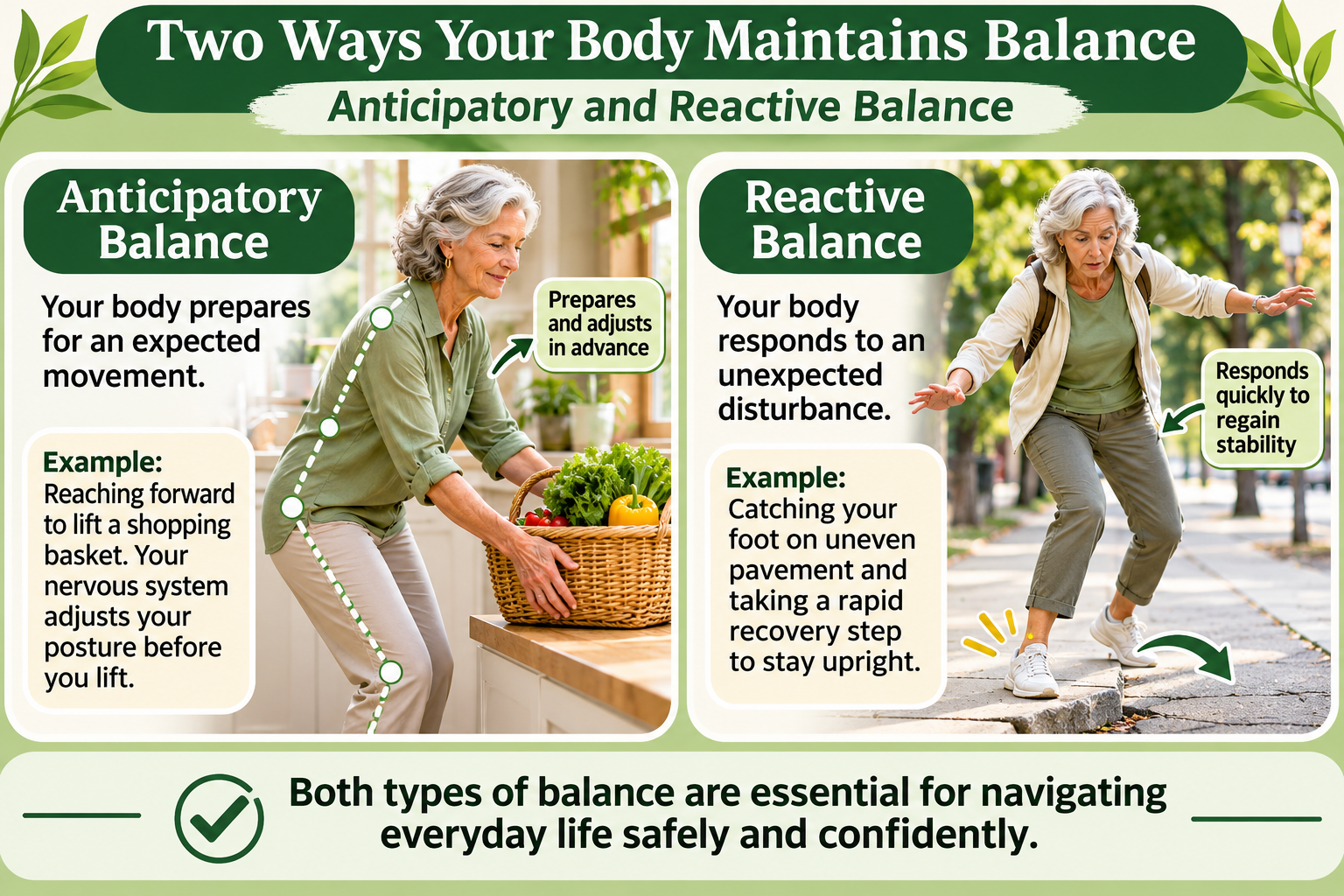
Anticipatory Versus Reactive Balance
Our nervous system uses different strategies to maintain stability depending on whether a movement is expected or unexpected.
Anticipatory balance involves preparing the body for a movement before it occurs.
For example, when you reach forward to lift a heavy object, your nervous system makes subtle adjustments to your posture and muscle activity in anticipation of the change in weight distribution.
Reactive balance involves responding to a disturbance that has already occurred.
If someone accidentally bumps into you, or your foot slips on a wet surface, your nervous system must respond rapidly to restore stability.
Both abilities are important, but they place different demands on the body.
Age-related changes in reaction speed, muscle power, and sensory processing can make unexpected disturbances particularly challenging.
Can Reactive Balance Be Trained?
Researchers have investigated an approach known as perturbation-based balance training.
A perturbation is an external disturbance that temporarily disrupts stability.
In controlled clinical or research environments, participants may experience carefully managed disturbances while wearing safety harnesses or receiving professional support.
Repeated exposure allows the nervous system to practice and refine its recovery responses.
A systematic review published in 2015 found promising reductions in falls among participants who received perturbation-based balance training.
However, the review included relatively few participants and a mixture of older adults and people with neurological conditions. Further research is needed to establish the most effective approaches for different populations.
This research highlights an important distinction: being able to stand steadily on one leg does not necessarily mean you are equally skilled at recovering from an unexpected stumble.
Different balance challenges develop different abilities.
The Importance of Muscle Power
Recovering from a stumble often requires more than muscle strength. It requires the ability to generate force rapidly.
This is known as muscle power.
Your muscles may be strong enough to perform ordinary activities but less capable of producing the rapid response needed to regain your footing.
Maintaining muscle strength and developing the ability to move efficiently is therefore complements balance training.
Perturbation-based training should not be attempted independently at home. Deliberately creating a slip, trip, or unexpected loss of balance can cause serious injury.
A physical therapist can determine whether this type of training is appropriate and provide a safe environment in which to practice.
Dual-Task Balance: When Your Brain Has More Than One Job
Have you ever noticed someone stop walking when they become deeply engaged in a conversation?
Although walking may appear automatic, it requires ongoing communication between the brain, sensory systems, and muscles.
When we introduce another task, such as talking, counting, or making a decision, these activities compete for some of the brain's attention.
This is known as dual-task interference.
As we age, coordinating movement while performing another task can become more demanding, particularly in unfamiliar or distracting environments.
The Hidden Mental Demands of Walking
Consider some of the situations we encounter during an ordinary day:
-
Walking while talking to a companion.
-
Navigating a supermarket while searching for a particular product.
-
Carrying groceries while opening a door.
-
Walking through a crowded area while looking for directions.
-
Crossing a street while monitoring approaching traffic.
Each situation requires the brain to manage multiple demands simultaneously.
When attention is divided, walking speed, step length, or movement patterns may change.
These changes can become more pronounced when the environment is unfamiliar, the mental task is demanding, or an individual already has difficulties with mobility or balance.
This helps explain why someone who walks confidently around their home may feel considerably less steady in a busy shopping center.
The physical ability to walk has not necessarily changed. The demands placed on the nervous system have increased.
Can Dual-Task Training Help?
A 2025 systematic review and meta-analysis examined 44 studies involving 2,782 older adults.
The researchers reported improvements in dynamic balance and functional mobility, as well as reductions in fall frequency, following dual-task exercise interventions.
However, the certainty of the evidence varied, and further research is needed to determine the most effective training approaches.
Dual-task training is not about encouraging people to become distracted while walking. It is about developing the ability to manage competing demands more effectively.
For some individuals, particularly those with existing balance difficulties, this type of training is best introduced under professional supervision.
Knowing When to Give Your Full Attention
Interestingly, stopping walking briefly to concentrate on a conversation or another demanding task can be a sensible safety strategy.
If you need to check directions on your phone, look for something in your bag, or concentrate on a complicated conversation, there is nothing wrong with stopping momentarily.
Similarly, when navigating unfamiliar stairs or uneven ground, giving your full attention to the task may be more appropriate than attempting to manage several activities simultaneously.
The objective is not to prove that you can multitask. It is to move safely and confidently.
Does Walking Improve Balance?
Walking is one of the most accessible forms of physical activity and offers substantial benefits for cardiovascular health, endurance, mobility, and general well-being.
Walking also requires coordination, repeated weight transfer, and control of the body during movement.
However, ordinary walking does not necessarily challenge all the systems involved in maintaining and recovering balance.
When we walk along familiar, relatively flat surfaces, we may repeatedly perform movements that our nervous system has already mastered.
Dedicated balance training introduces different demands, such as maintaining narrower foot positions, transferring weight in different directions, and controlling less familiar movements.
The scientific evidence for walking alone as a fall-prevention intervention remains less certain than that for structured balance and functional exercise programs.
This does not diminish the value of walking. It simply highlights why walking, strength training, and balance exercises all deserve a place in a well-rounded physical activity routine.
Our companion article, Better Balance After 60: Practical Exercises to Reduce Your Risk of Falling, provides examples of exercises that develop abilities ordinary walking may not sufficiently challenge.
Making Your Everyday Environment Safer
Improving your physical capabilities is only one part of reducing fall risk.
Even someone with excellent balance can trip over an unexpected obstacle or slip on a wet surface.
Making a few practical adjustments to your everyday environment can complement your physical training.
Choose Supportive Footwear
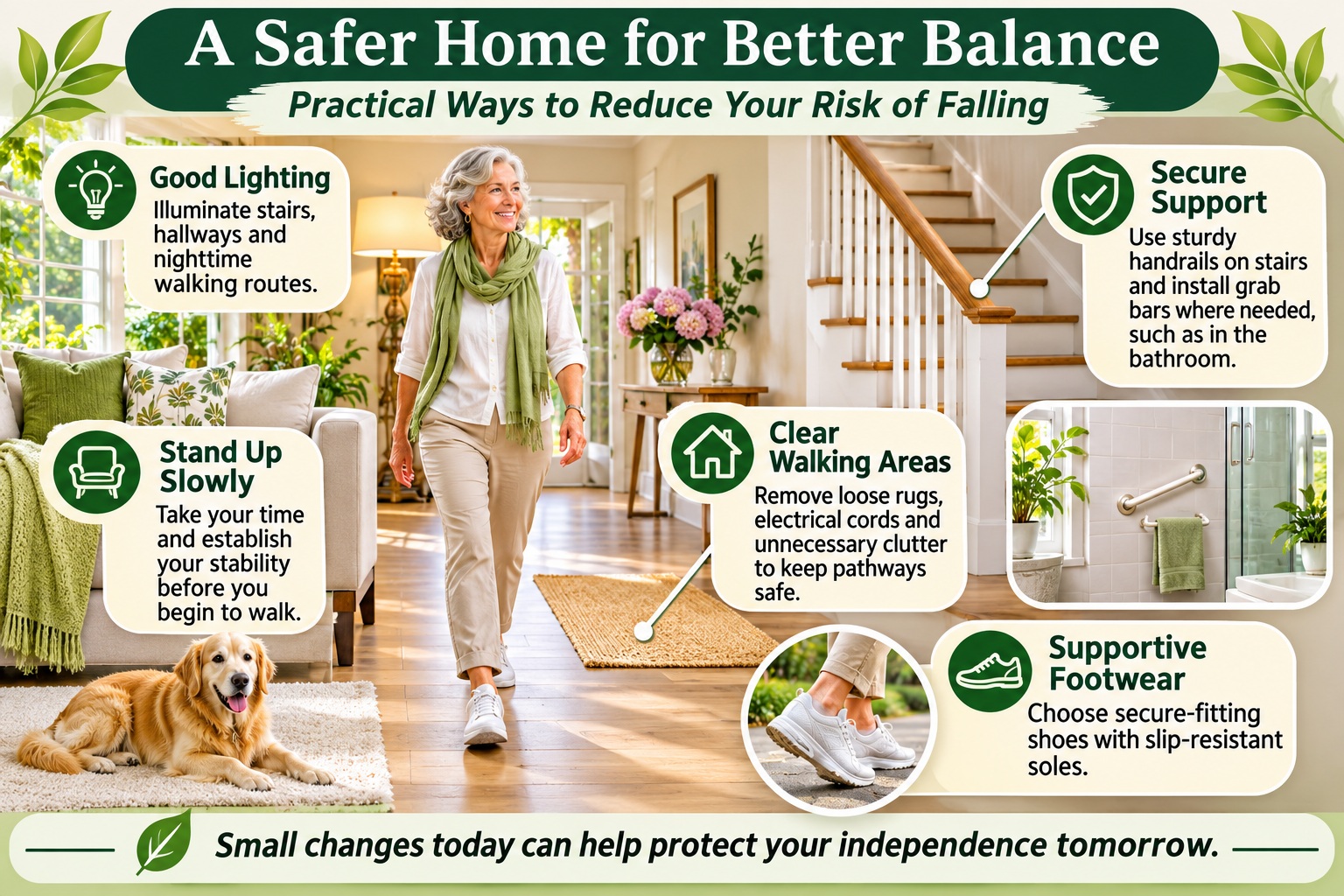
Shoes with a secure fit, relatively low heels, and slip-resistant soles can provide a more stable foundation for movement.
Loose slippers, worn soles, and shoes that slide around on the feet may introduce unnecessary difficulties.
Comfort is important, but so is the ability of footwear to remain securely attached to your feet as you move.
Improve Lighting
Adequate lighting is particularly important around stairs, hallways, entrances, and bathrooms.
As discussed in our article Staying Steady After 60: How to Improve Balance and Protect Your Independence, age-related changes in vision can make it more difficult to navigate poorly lit environments, even when wearing prescription glasses.
Our eyes may take longer to adjust when moving from bright surroundings into darkness.
Allowing time for this adjustment, improving lighting, and installing nightlights along frequently used routes can help make movement safer.
Remove Unnecessary Trip Hazards
Loose rugs, electrical cords, cluttered walkways, and uneven floor surfaces can increase the likelihood of stumbling.
Frequently used items should also be stored within comfortable reach, reducing the need to stand on chairs or stretch into unstable positions.
Secure handrails and appropriately installed grab bars can provide additional support where necessary.
Review Your Vision and Medications
Regular eye examinations can help identify changes that affect your ability to navigate safely.
Certain medications may also contribute to dizziness, drowsiness, or changes in blood pressure.
These effects may become particularly important when several medications are taken together.
If you notice these symptoms, discuss them with your doctor or pharmacist rather than adjusting your medications independently.
Take Your Time When Standing Up
Have you ever stood up quickly and experienced a brief feeling of lightheadedness?
When we move from sitting or lying down to standing, gravity causes some blood to temporarily shift toward the lower part of the body.
Normally, the cardiovascular system responds rapidly to maintain adequate blood flow to the brain.
Sometimes this response is insufficient, resulting in a temporary drop in blood pressure known as orthostatic hypotension, which can cause dizziness, blurred vision, or faintness.
If you are prone to lightheadedness, rise slowly and establish your stability before walking.
Frequent or persistent symptoms warrant medical assessment.
The objective of these environmental and behavioral adjustments is not to eliminate every physical challenge from your life. It is to distinguish between beneficial, controlled challenges during exercise and unnecessary hazards in everyday situations.
Why Bone Health Also Matters
Although reducing the likelihood of falling is important, it is equally worthwhile to consider what happens if a fall does occur.
People with osteoporosis may be more vulnerable to fractures, even following relatively minor falls.
Maintaining bone health and developing better balance are therefore complementary strategies for protecting physical independence.
Our article Strong Bones After 50: Understanding Bone Loss and Osteoporosis explores the changes that occur within our bones as we age and the steps we can take to support skeletal health.
Building a Well-Rounded Physical Activity Routine
No single type of exercise develops every physical ability we need to remain independent.
A comprehensive approach incorporates several complementary forms of activity.
| Type of exercise | Main contribution |
|---|---|
| Aerobic exercise | Endurance and cardiovascular fitness |
| Resistance training | Muscle strength and physical capacity |
| Balance training | Stability, coordination, and postural control |
| Mobility exercises | Comfortable and functional movement |
Aerobic fitness helps us sustain physical activity without becoming excessively fatigued.
Muscle strength provides the physical capacity to perform movements and respond to challenges.
Balance training helps us use that capacity with greater control and stability.
Mobility allows us to move through the ranges of motion required for everyday activities.
International physical activity guidelines recognize the importance of combining several forms of exercise rather than relying exclusively on one.
There is no need to introduce everything at once. Starting with manageable activities and gradually developing a more comprehensive routine can make exercise feel less overwhelming and easier to sustain.
The Bottom Line
Maintaining balance is about much more than remaining steady while standing still.
Everyday life requires us to respond to unexpected disturbances, navigate changing environments, divide our attention, and make rapid adjustments while moving.
Understanding these demands can help us develop a more comprehensive approach to maintaining physical independence.
Regular physical activity, appropriately challenging balance training, muscle strengthening, and sensible environmental adjustments all have a role to play.
We cannot eliminate every possibility of falling, but we can take meaningful steps to reduce our vulnerability and improve our ability to respond to everyday challenges.
The purpose of fall prevention is not to encourage us to live more cautiously. It is to help us continue living actively, confidently, and safely.
Medical Disclaimer: This article is provided for educational and informational purposes only and is not intended to replace professional medical advice, diagnosis, or treatment. Consult a qualified healthcare professional regarding persistent dizziness, falls, balance difficulties, medication-related symptoms, or changes in mobility. Specialized reactive balance and dual-task training may require professional assessment and supervision.
Frequently Asked Questions
Why do I feel less steady in crowded places?
Crowded environments place greater demands on visual processing, attention, coordination, and decision-making. Your brain must continuously monitor other people, obstacles, and changes in direction. This can make walking more demanding, particularly if you already experience balance difficulties.
Why do I sometimes stop walking when talking?
Walking and talking both require attention. When a conversation becomes particularly demanding, stopping briefly may allow your brain to concentrate more effectively. This can be a sensible strategy, although a noticeable new difficulty managing everyday tasks while walking may warrant professional assessment.
Can practicing balance exercises help me recover from a stumble?
Regular balance and strength exercises can develop abilities that contribute to stability. However, recovering from an unexpected disturbance also involves specific reactive balance skills. Specialized, professionally supervised training may provide additional benefits.
Does walking every day reduce my risk of falling?
Walking supports endurance, mobility, and general physical health. However, walking alone may not sufficiently develop all the abilities involved in fall prevention. Combining walking with strength and dedicated balance training provides a more comprehensive approach.
Should I be concerned if I frequently feel dizzy when standing up?
Occasional lightheadedness can have several causes, including temporary changes in blood pressure. Frequent, persistent, or worsening dizziness should be assessed by a healthcare professional, particularly if it affects your stability or is accompanied by fainting.
References
Mansfield A et al. Physical Therapy, 2015.
Investigates whether training the body's responses to unexpected disturbances can help reduce falls.
2025.
Examines the effectiveness of dual-task training in improving balance, functional mobility, and fall-related outcomes among older adults.
Exercise for Preventing Falls in Older People Living in the Community
Sherrington C et al. Cochrane Database of Systematic Reviews, 2019.
Evaluates different forms of exercise and their effectiveness in reducing falls among older adults.
Better Health Channel, Victorian Government, Australia.
Practical guidance on environmental hazards, footwear, vision, physical activity, and other factors influencing fall risk.
WHO Guidelines on Physical Activity and Sedentary Behaviour
World Health Organization, 2020.
Evidence-based international recommendations concerning aerobic activity, muscle strength, functional balance, and physical activity in older adults.
Continue Learning
Explore the physical abilities and health strategies that contribute to maintaining independence as you age.