Have you ever noticed that carrying a heavy shopping bag feels a little harder than it used to? Perhaps climbing a flight of stairs leaves your legs more tired, or getting up from a low chair requires a little extra effort.
These small changes are easy to dismiss as part of getting older.
But they may also be early reminders of something important: the strength of our muscles plays a major role in how well we age.
Muscle strength isn't simply about lifting weights or looking physically fit. It helps us move confidently, maintain balance, manage everyday tasks, and preserve the freedom to live independently.
The encouraging news is that muscles remain responsive to exercise well into later life. Even people who haven't exercised regularly for years can often improve their strength with an appropriately designed program.
Understanding why muscle matters — and what we can do to preserve it — is one of the most useful steps toward healthier aging.
Quick Summary
-
Muscle strength supports independence. It helps with walking, climbing stairs, lifting objects, and getting up from chairs.
-
Muscle changes with age. Without sufficient physical activity, strength and muscle mass tend to decline over time.
-
Resistance training is particularly important. Challenging muscles regularly helps maintain and improve strength.
-
Protein supports muscle maintenance. Older adults may need to pay closer attention to both protein intake and overall nutrition.
-
It's rarely too late to benefit. Research shows that many older adults can improve strength through suitable exercise, even after years of inactivity.

Why Muscle Strength Becomes More Important With Age
Imagine being able to walk comfortably along the beach, carry your own groceries, enjoy a holiday, or get down onto the floor to play with a grandchild — and stand up again without difficulty.
These activities may seem ordinary, but they depend on a remarkable combination of muscle strength, balance, coordination, and endurance.
As we grow older, maintaining these abilities becomes increasingly important.
Muscle Loss Is Common, but Not Entirely Inevitable
From middle age onward, many adults gradually lose muscle mass and strength.
Researchers use the term sarcopenia to describe a progressive muscle condition associated with reduced strength, muscle quantity or quality, and, in more advanced cases, physical performance.
Sarcopenia is more than the ordinary experience of feeling less fit. It can affect mobility, increase the likelihood of falls, and make everyday activities more difficult.
Importantly, muscle strength and muscle size are not identical.
A person can lose strength faster than muscle mass because aging also affects the nervous system and the way muscles generate force.
This helps explain why measuring muscle size alone doesn't tell the whole story.
Why Some People Lose Strength Faster Than Others
Aging contributes to changes in muscle tissue, but lifestyle and health circumstances also matter.
Factors that can accelerate muscle decline include:
-
Long periods of physical inactivity
-
Extended bed rest or recovery after illness
-
Inadequate dietary protein or overall food intake
-
Certain chronic illnesses
-
Reduced opportunities for challenging physical movement
This means that two people of the same age may have very different levels of physical capability.
One person may struggle with stairs, while another comfortably hikes, cycles, or participates in recreational sports.
Age matters, but it does not determine everything.
Muscle Is More Than a Movement System
We usually think about muscles when we walk, lift, or exercise.
Yet skeletal muscle also plays an important role in metabolic health.
Muscles Help Regulate Blood Sugar
After a meal containing carbohydrates, glucose enters the bloodstream.
Skeletal muscle is one of the body's major destinations for that glucose. Insulin helps muscle cells take up glucose and use or store it.
Physical activity also stimulates glucose uptake through mechanisms that do not depend entirely on insulin.
This is one reason regular movement and resistance exercise can improve insulin sensitivity.
Maintaining active muscle tissue therefore supports more than physical strength. It can contribute to healthier blood glucose regulation and overall metabolic function.
Muscle Strength Helps Protect Independence
Consider the simple action of standing up from a chair.
It requires your legs and hips to generate enough force to lift your body against gravity.
Now imagine repeating that movement throughout the day — getting out of bed, standing from the dining table, stepping into a car, or rising from the sofa.
When strength declines, these movements can become more demanding.
Maintaining strength gives the body greater capacity to manage everyday physical challenges.
The goal isn't necessarily to become athletic. It's to preserve the physical freedom to do the things that matter to you.
Can You Build Muscle After 60, 70, or Even 80?
Yes. Research consistently shows that older adults can improve muscular strength through resistance training.
Even studies involving very old or physically frail participants have demonstrated meaningful improvements when exercise programs are appropriately supervised and progressed.
However, the size of the improvement varies. Health conditions, nutritional status, training intensity, and consistency all influence results.
The important message is that aging does not eliminate the body's ability to adapt.
What Resistance Training Actually Means
Resistance training involves asking muscles to work against a force.
That force might come from:
-
Your own body weight
-
Resistance bands
-
Dumbbells or other free weights
-
Gym resistance machines
-
Appropriately challenging everyday movements
The objective is to gradually provide enough resistance to stimulate adaptation.
This is sometimes called progressive resistance training.
As an exercise becomes easier, the resistance or difficulty can be increased appropriately.
For example, someone might begin by standing up from a sturdy chair using their hands for support. As strength improves, they may progress to standing without using their hands.
Eventually, they might use a lower chair or add resistance, provided doing so is safe.
The principle is simple: muscles need a reason to remain strong.
How Much Strength Training Do Older Adults Need?
The World Health Organization recommends that adults, including older adults, perform muscle-strengthening activities involving major muscle groups on at least two days each week.
For older adults, the WHO also recommends multicomponent physical activity emphasizing functional balance and strength on three or more days per week to enhance functional capacity and help prevent falls.
These recommendations are compatible: strength work can form part of a broader weekly exercise routine.
You do not need to begin with a demanding gym schedule.
A suitable program can start modestly and become more challenging as confidence and physical capacity improve.
Focus on Useful Movements
For everyday independence, several movement patterns are particularly valuable.
Standing and sitting: Strengthens muscles involved in rising from chairs and toilets.
Stepping and climbing: Helps maintain the leg strength needed for stairs and changes in elevation.
Pushing and pulling: Supports tasks such as opening heavy doors, moving objects, and carrying shopping.
Lifting and carrying: Helps prepare the body for ordinary physical demands.
Balancing and stabilizing: Supports safer movement and confidence, particularly when combined with appropriate balance training.
These movements can be practiced through different exercises depending on individual ability.
Someone with joint pain, osteoporosis, cardiovascular disease, or significant mobility limitations may need modifications or professional guidance.
The Role of Protein in Maintaining Muscle
Exercise provides a stimulus for muscle adaptation.
Protein supplies the amino acids needed to repair and maintain muscle tissue.
Both are important.
Why Protein Deserves More Attention After 50
As we age, muscles may become less responsive to the muscle-building effects of dietary protein.
Researchers call this phenomenon anabolic resistance.
It does not mean older muscles cannot grow or recover. Rather, they may require a stronger combination of exercise and nutritional stimulation.
Some expert groups recommend that healthy older adults consume approximately 1.0–1.2 grams of protein per kilogram of body weight daily, compared with the standard adult recommended dietary allowance of 0.8 grams per kilogram.
Individual requirements vary, and people with certain medical conditions, particularly kidney disease, should seek personalized advice before increasing protein intake.
What Does That Look Like in Everyday Meals?
Protein-rich foods include:
-
Eggs
-
Yogurt, milk, and cheese
-
Fish and seafood
-
Chicken and lean meat
-
Tofu, tempeh, and soy foods
-
Lentils, beans, and chickpeas
Including protein-containing foods across meals can make it easier to meet daily requirements.
There is no need to assume that expensive protein powders or supplements are essential.
For many people, ordinary foods can provide adequate protein.
The more important questions are whether total intake is sufficient, whether meals are nutritionally balanced, and whether exercise is providing a suitable stimulus for muscle maintenance.
Why Walking Alone May Not Be Enough
Walking is an excellent activity for many older adults.
It supports cardiovascular fitness, helps maintain mobility, and provides opportunities to spend time outdoors.
But walking and resistance training challenge the body in different ways.
Walking may not provide enough resistance to maintain or improve strength across all major muscle groups, particularly as someone becomes accustomed to their usual walking routine.
This is why combining regular walking with muscle-strengthening activities is generally more beneficial than relying on walking alone.
The same principle applies to other enjoyable activities, such as swimming or cycling.
They can contribute to fitness and health, but a balanced routine should also include exercises that specifically challenge muscular strength.
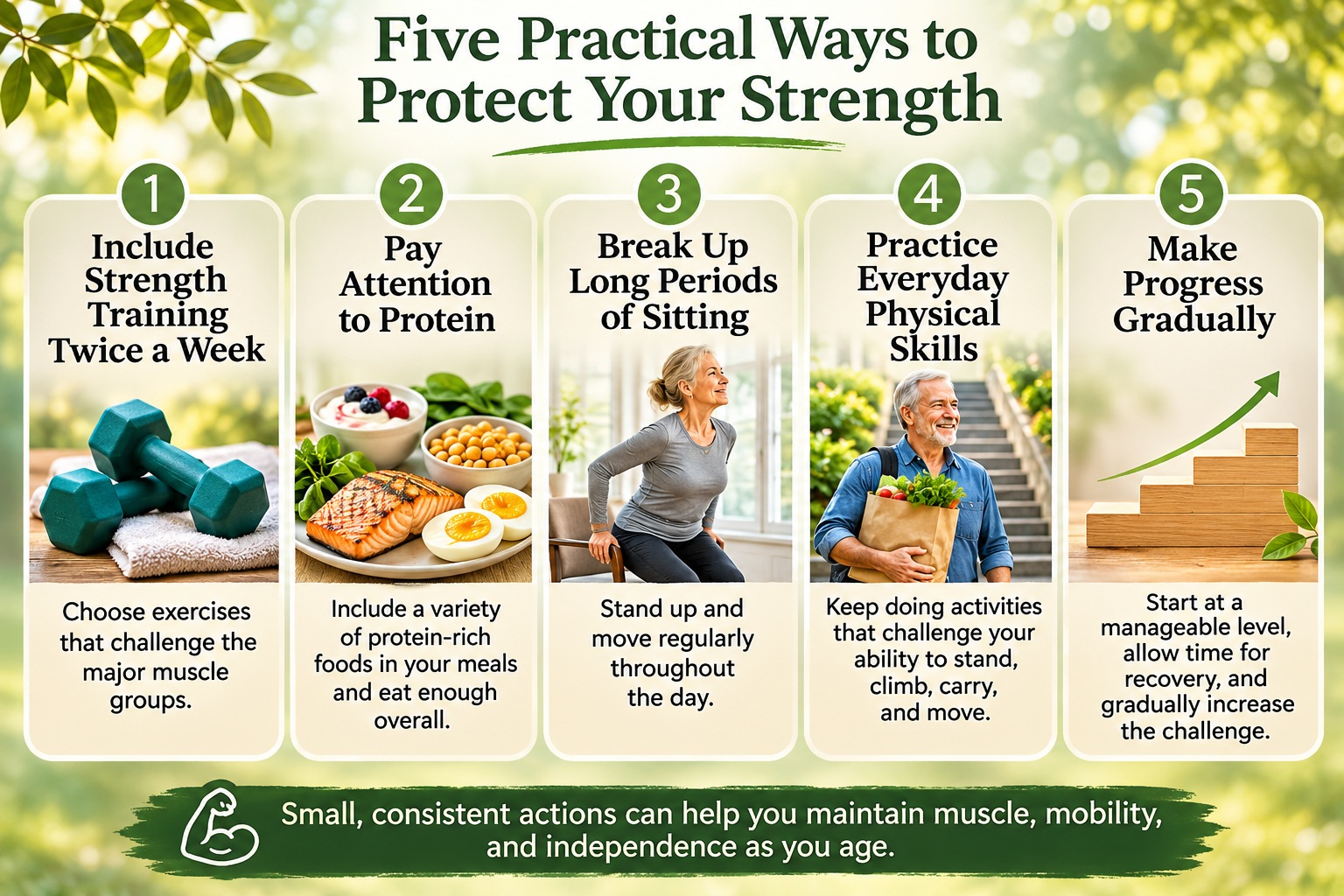
Five Practical Ways to Protect Your Strength
You don't need to transform your entire lifestyle overnight.
Small, consistent changes can provide a realistic starting point.
1. Include Strength Training Twice a Week
Choose exercises appropriate to your abilities that challenge the major muscle groups.
If you're new to resistance training, consider seeking guidance from a qualified exercise professional.
2. Pay Attention to Protein
Include a variety of protein-rich foods in your meals and ensure you're eating enough overall.
People with poor appetite, unintentional weight loss, or medical conditions may benefit from advice from a registered dietitian.
3. Break Up Long Periods of Sitting
Stand up and move regularly throughout the day.
Although brief movement breaks are not a replacement for structured strength training, they reduce prolonged inactivity and create opportunities to use your muscles.
4. Practice Everyday Physical Skills
Where safe, continue doing activities that challenge your ability to stand, climb, carry, and move.
The aim is to maintain the skills that support everyday independence.
5. Make Progress Gradually
Consistency matters more than enthusiasm during the first week.
Start at a manageable level, allow time for recovery, and gradually increase the challenge.
If you experience unusual pain, dizziness, chest discomfort, or significant breathlessness, stop and seek appropriate medical advice.
A Different Way to Think About Growing Older
We often measure healthy aging through numbers.
Blood pressure. Cholesterol. Blood glucose. Body weight.
These measurements can provide valuable information, but they don't tell us everything about how well a person is aging.
There are other questions worth asking.
Can you carry your own shopping?
Can you climb stairs comfortably?
Can you get up from a chair without struggling?
Can you enjoy the activities that give your life meaning?
Muscle strength contributes to the answers.
It is not the only factor. Balance, joint health, cardiovascular fitness, neurological function, and overall health also matter.
But maintaining strength is one of the practical ways we can support physical independence.
And unlike our chronological age, muscular strength is something we can often improve.
The Bottom Line
Growing older doesn't mean giving up the activities that make life enjoyable.
Maintaining muscle strength can help you continue walking, traveling, gardening, carrying groceries, climbing stairs, and participating in everyday life with greater confidence.
You don't need to become a bodybuilder or spend hours in the gym.
You need a realistic plan that challenges your muscles, supports good nutrition, and can be maintained over time.
The real reward of staying strong isn't how much weight you can lift. It's how much of the life you enjoy you can continue to live.
Medical Disclaimer: This article is provided for educational and informational purposes only and is not intended to replace professional medical advice, diagnosis, or treatment. Consult a qualified healthcare professional regarding persistent dizziness, falls, balance difficulties, medication-related symptoms, or changes in mobility. Specialized reactive balance and dual-task training may require professional assessment and supervision.
Frequently Asked Questions
Is muscle loss after 50 inevitable?
Some age-related changes in muscle are common, but the rate and consequences vary considerably. Resistance training, adequate nutrition, and regular physical activity can help preserve or improve muscle strength.
Can a 70-year-old build muscle?
Yes. Many adults in their 70s and beyond can increase strength and, in some cases, muscle mass through appropriately designed resistance training. Results vary according to health, training, and nutrition.
Is walking enough to maintain muscle strength?
Walking provides important health benefits, but it generally does not replace resistance training for maintaining strength across major muscle groups.
How often should older adults lift weights?
General guidelines recommend muscle-strengthening activities at least twice weekly. The appropriate exercises, resistance, and progression depend on individual circumstances.
Do older adults need protein supplements?
Not necessarily. Many people can meet their protein needs through ordinary foods. Supplements may be useful in selected circumstances, but they are not automatically required.
What is the difference between muscle loss and sarcopenia?
Muscle mass and strength may decline gradually with age. Sarcopenia is a recognized muscle disorder characterized primarily by low muscle strength, with muscle quantity or quality and physical performance used in further assessment.
References
Cruz-Jentoft AJ, et al. (2019). Sarcopenia: Revised European Consensus on Definition and Diagnosis. Explains how sarcopenia is identified and why declining muscle strength is an important indicator of muscle health in older adults. Provides the scientific foundation for understanding age-related muscle loss and its effects on physical independence.
World Health Organization. (2020). WHO Guidelines on Physical Activity and Sedentary Behaviour. Provides international evidence-based recommendations for physical activity, including muscle-strengthening and balance exercises for older adults. Supports the article's practical guidance on how frequently people should exercise.
Fragala MS, et al. (2019). Resistance Training for Older Adults: Position Statement From the National Strength and Conditioning Association. Reviews research demonstrating how appropriately designed resistance training can improve muscular strength, physical function, and mobility in older adults. Supports the article's message that meaningful improvements are possible later in life.
Bauer J, et al. (2013). Evidence-Based Recommendations for Optimal Dietary Protein Intake in Older People. Examines protein requirements in older adults and provides expert recommendations for supporting muscle maintenance. Supports the discussion of anabolic resistance and why adequate dietary protein becomes particularly important with age.
Fiatarone MA, et al. (1994). Exercise Training and Nutritional Supplementation for Physical Frailty in Very Elderly People. Reports a clinical trial involving very elderly, physically frail participants, demonstrating that progressive resistance exercise can substantially improve strength and physical performance. Provides compelling evidence that the ability to respond to strength training can persist into advanced age.
Chodzko-Zajko WJ, et al. (2009). Exercise and Physical Activity for Older Adults. An American College of Sports Medicine position stand examining the benefits of physical activity for older adults. Supports the broader discussion of exercise, functional ability, and maintaining health and independence as we age.
Continue Learning
Discover how muscle strength, bone health, and balance work together to help you remain active, confident, and independent as you age.
Strong Bones After 50: Understanding Bone Loss and Osteoporosis
Staying Steady After 60: How to Improve Balance and Protect Your Independence
Better Balance After 60: Practical Exercises to Reduce Your Risk of Falling
Beyond Balance: How to Stay Steady and Safe in Everyday Life After 60