You step on the scale after a week of eating much less than usual and see the number drop quickly. At first, it can feel like proof that the diet is working. But when weight comes off rapidly—especially after 50—not all of it is necessarily body fat.
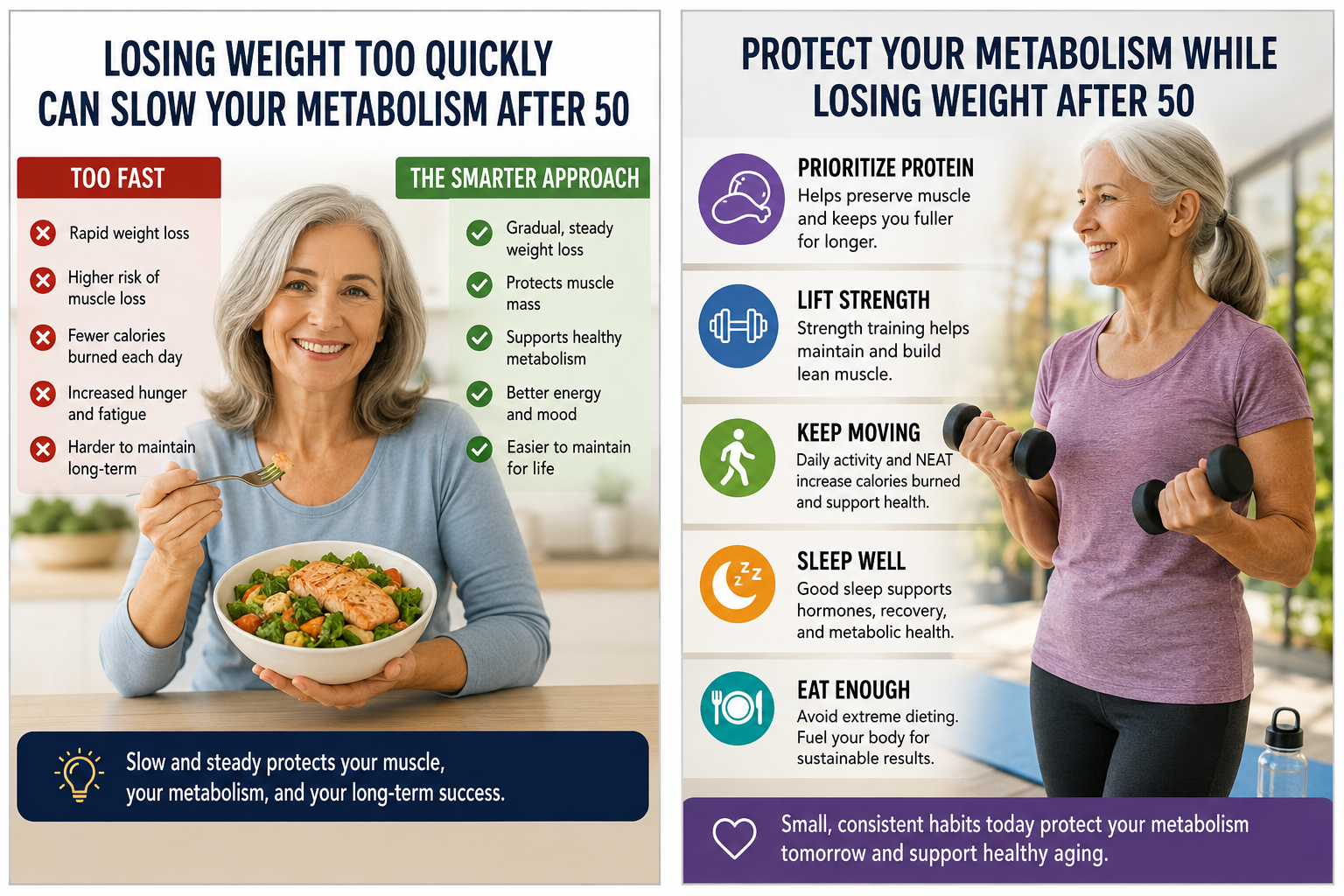
Very restrictive diets can increase the amount of muscle lost along with fat. Because muscle supports strength, mobility, and daily energy expenditure, preserving it becomes increasingly important as we age. Your body can also adapt to a prolonged calorie deficit by conserving energy, one reason maintaining rapid weight loss can become difficult.
That doesn't mean losing weight will "damage" your metabolism. Some reduction in energy needs is a normal part of becoming lighter. The goal is to lose excess body fat while protecting as much muscle as possible and avoiding unnecessarily aggressive calorie restriction.
After 50, a slower, sustainable approach can often do more than produce a lower number on the scale—it can help you become leaner while protecting the strength and metabolic health you'll want for the years ahead.
Continue learnging: Can Eating Too Little Slow Your Metabolism After 50?
Quick Summary
- Losing weight very quickly can increase the amount of muscle lost along with body fat.
- Muscle supports strength, mobility, and daily energy expenditure, making muscle preservation especially important after 50.
- Your body can adapt to prolonged calorie restriction by conserving energy—a response known as adaptive thermogenesis.
- Some reduction in calorie needs during weight loss is normal and does not mean your metabolism is "broken."
- Adequate protein, strength training, regular movement, and a moderate calorie deficit can help protect muscle during weight loss.
- Sustainable weight loss is about more than losing weight quickly—it's about improving body composition while supporting long-term health.
What Happens to Your Metabolism When You Lose Weight?
Metabolism refers to all the processes your body uses to produce and use energy. Your total daily energy expenditure includes:
- Calories burned at rest (resting metabolic rate)
- Energy used during physical activity
- Calories used to digest and process food
- Everyday movement such as walking, standing, and household tasks
As you lose weight, your body generally requires fewer calories because there is less body mass to maintain and move. This is a normal part of weight loss and does not mean your metabolism has been damaged.
Your body can also become somewhat more energy-efficient during weight loss, particularly during a prolonged calorie deficit. And if weight is lost too aggressively, a greater loss of muscle can further reduce daily energy expenditure.
This is why how you lose weight can matter almost as much as how much weight you lose.
Why Rapid Weight Loss Can Affect Metabolism
Very restrictive diets often create a large calorie deficit. While this can produce quick results on the scale, it can also increase the amount of muscle lost along with body fat.
Muscle contributes to resting energy expenditure and becomes increasingly important for strength and physical function as we age. Losing too much muscle during weight loss can therefore work against both metabolic health and healthy aging.
A large or prolonged calorie deficit can also contribute to:
- Increased hunger
- Lower energy levels
- Reduced exercise performance
- Greater difficulty maintaining weight loss over time
The body can also respond by conserving energy, so you may burn somewhat fewer calories than expected for your new body size.
These changes don't mean your metabolism is damaged. They help explain why an aggressive approach that produces fast results on the scale can sometimes make long-term weight management harder.
The Importance of Muscle After 50
Muscle mass and strength tend to decline gradually with age, making muscle preservation increasingly important after 50. Aggressive dieting can add to that loss if the body breaks down muscle as well as fat during weight loss.
Maintaining muscle can help:
-
Support strength, mobility, and independence
-
Maintain resting energy expenditure
-
Support balance and physical function
-
Make healthy weight management easier over time
This is why weight loss after 50 shouldn't focus only on the number on the scale. Preserving muscle through adequate protein and regular strength training can help improve body composition while supporting healthy aging.
Continue learning: Does Building Muscle After 50 Really Increase Metabolism?
How Your Body Adapts to Weight Loss
When you lose weight, your body naturally needs less energy because it has a smaller body to maintain. But sometimes energy expenditure decreases a little more than would be expected from the change in body weight and composition alone. Researchers call this adaptive thermogenesis.
It is essentially one of the body's energy-conservation responses to weight loss and a prolonged calorie deficit.
Adaptive thermogenesis can involve:
- A reduction in resting energy expenditure
- Fewer calories burned through everyday movement
- Greater energy efficiency during some physical activities
At the same time, weight loss can trigger other biological adaptations, including increased hunger and changes in appetite-regulating hormones. Together, these responses can make continued weight loss—and keeping lost weight off—more challenging.
Adaptive thermogenesis is a normal biological response, not a sign that your metabolism has stopped working. Its size varies between individuals and can change over time, which is another reason to favor sustainable weight-loss strategies over extreme calorie restriction.
How Fast Should You Lose Weight After 50?
There is no single ideal rate of weight loss for everyone. Your starting weight, health, activity level, and individual needs all matter.
For many adults, a gradual loss of about 1 to 2 pounds (0.5 to 0.9 kg) per week is commonly recommended as a general guideline. But after 50, faster isn't necessarily better. A slower rate can be entirely appropriate, particularly if it helps you maintain muscle, eat enough protein, stay active, and follow the approach comfortably over time.
Rather than focusing only on how quickly the scale changes, pay attention to whether your weight-loss approach allows you to:
-
Maintain strength and muscle
-
Eat a nutritious, satisfying diet
-
Stay physically active
-
Avoid excessive hunger and fatigue
-
Build habits you can realistically maintain
Some weeks you may lose more, some less, and occasionally the scale may barely change at all. Weight loss rarely follows a perfectly straight line.
The better goal after 50 is not the fastest possible weight loss, but steady progress that reduces excess body fat while protecting muscle, strength, and long-term health.
Strategies That May Help Protect Your Metabolism During Weight Loss
The goal during weight loss isn't to prevent every metabolic adaptation—that isn't realistic. Instead, focus on habits that help preserve muscle, maintain activity, and make your approach easier to sustain.
Prioritize Protein
Protein helps preserve muscle during weight loss and can also improve fullness after meals. Include a source of protein regularly throughout the day, such as fish, eggs, Greek yogurt, poultry, lean meat, tofu, or legumes.
Getting enough protein becomes particularly important when you're eating fewer calories because you want as much of the weight lost as practical to come from body fat rather than muscle.
Continue learning: Why Protein Becomes More Important After 50
Include Strength Training
Resistance exercise gives your body a reason to maintain muscle while you lose weight. Bodyweight exercises, resistance bands, free weights, and weight machines can all be effective.
For many adults, strength training two or more times per week can provide meaningful benefits for muscle, strength, and physical function.
Continue learning: Why Strength Training Is One of the Best Ways to Boost Metabolism After 50
Stay Physically Active
Structured exercise matters, but so does the movement you accumulate throughout the day. Walking, gardening, housework, cycling, swimming, taking the stairs, and simply spending less time sitting can all contribute to daily energy expenditure.
During weight loss, maintaining everyday movement is particularly useful because people can sometimes become less active without realizing it when calorie intake is reduced.
Avoid Extreme Diets
A diet only works in the long term if you can realistically live with it. Severe calorie restriction can increase hunger, fatigue, muscle loss, and the temptation to abandon the plan altogether.
Aim for an approach that provides enough nutrition and energy to support your daily life while still allowing gradual progress. Sustainable habits are usually more valuable than short bursts of extreme restriction.
Focus on Long-Term Success Rather Than Speed
It's easy to judge a weight-loss plan by how quickly the number on the scale changes. But the real test is whether the habits behind that change can be maintained for months and years.
Small, consistent improvements in nutrition, strength training, everyday movement, and sleep can add up to meaningful results over time. A slower approach that protects muscle and fits comfortably into your life can ultimately be more successful than a restrictive plan you can't sustain.
The goal isn't to lose weight as quickly as possible. It's to lose it in a way that helps you stay stronger, healthier, and better able to maintain the results.
The Bottom Line
Losing weight quickly after 50 doesn't automatically damage your metabolism, but an aggressive calorie deficit can increase muscle loss and trigger energy-conserving adaptations that make weight loss harder to sustain.
A more balanced approach focuses on losing excess body fat while protecting muscle. Adequate protein, regular strength training, everyday movement, and a manageable calorie deficit can all help support that goal.
Some metabolic adaptation during weight loss is normal. Success isn't about preventing every change in the number of calories your body burns—it's about creating an approach you can maintain while protecting your strength, mobility, and long-term health.
Medical Disclaimer: This article is for educational purposes only and is not intended as medical advice. Always consult your healthcare provider before making significant changes to your diet, supplements, lifestyle, or treatment plan.
References
Centers for Disease Control and Prevention (CDC). Steps for Losing Weight. Guidance on gradual, sustainable weight loss and the commonly recommended rate of about 1–2 pounds per week.
Müller MJ, Bosy-Westphal A. Adaptive Thermogenesis with Weight Loss in Humans. Obesity. 2013;21(2):218–228. Reviews adaptive thermogenesis and how energy expenditure can decline during weight loss beyond what would be expected from changes in body weight and composition alone.
Müller MJ, Enderle J, Bosy-Westphal A. Changes in Energy Expenditure with Weight Gain and Weight Loss in Humans. Current Obesity Reports. 2016;5(4):413–423. Examines changes in energy expenditure during weight gain and loss, including metabolic adaptations that can influence long-term weight management.
Buskard ANL, et al. Resistance Training and Weight Loss in Older Adults: A Scoping Review. Sports Medicine - Open. 2023. Reviews the role of resistance training during weight loss in older adults, with particular attention to preserving lean mass, strength, and healthy body composition.
Domaszewski P, et al. Nutrition and Exercise Interventions to Improve Body Composition for Persons with Overweight or Obesity Near Retirement Age: A Systematic Review and Network Meta-Analysis of Randomized Controlled Trials. Advances in Nutrition. 2023. Examines how calorie restriction, exercise, and higher protein intake affect fat loss and muscle preservation in adults approaching older age.
Frequently Asked Questions
Can losing weight too quickly slow your metabolism after 50?
It can contribute to a reduction in energy expenditure, particularly if aggressive calorie restriction leads to muscle loss. Your body can also conserve energy during weight loss through adaptive thermogenesis. Some reduction in calorie needs is normal as you become lighter and does not mean your metabolism is damaged.
Why is muscle loss a concern during weight loss after 50?
Maintaining muscle becomes increasingly important with age. Losing too much muscle during weight loss can affect strength, mobility, physical function, and resting energy expenditure. Adequate protein and regular strength training can help protect muscle while you lose body fat.
What is a healthy rate of weight loss after 50?
For many adults, about 1 to 2 pounds (0.5 to 0.9 kg) per week is commonly used as a general guideline, but there is no ideal rate for everyone. Slower weight loss can be entirely appropriate, especially if it helps you preserve muscle, stay active, and maintain healthy eating habits.
How can I protect my metabolism while losing weight?
Focus on preserving muscle and maintaining healthy activity rather than trying to prevent every normal metabolic adaptation. Eating adequate protein, strength training regularly, staying physically active, getting enough sleep, and avoiding extreme calorie restriction can all support sustainable weight loss.
Is it bad to lose weight quickly if I feel fine?
Not necessarily, but very rapid weight loss can sometimes increase muscle loss or be difficult to maintain. If weight loss is unusually fast, unintentional, or accompanied by symptoms such as persistent fatigue or loss of appetite, speak with your healthcare provider.