
If you've been told your blood sugar is rising simply because you're getting older, that's only part of the story.
Insulin resistance doesn't develop overnight—and it rarely has a single cause. Instead, it usually builds gradually as several changes begin working together.
After 50, factors such as muscle loss, poor sleep, chronic stress, blood sugar spikes, and everyday habits can quietly make it harder for your body to respond to insulin.
The encouraging news is that once you understand what's driving these changes, you can take practical steps to slow, improve, and often even reverse the process naturally.
Quick Summary
Insulin resistance after 50 is rarely caused by just one thing. Instead, it usually develops as several age-related changes and everyday habits begin working together.
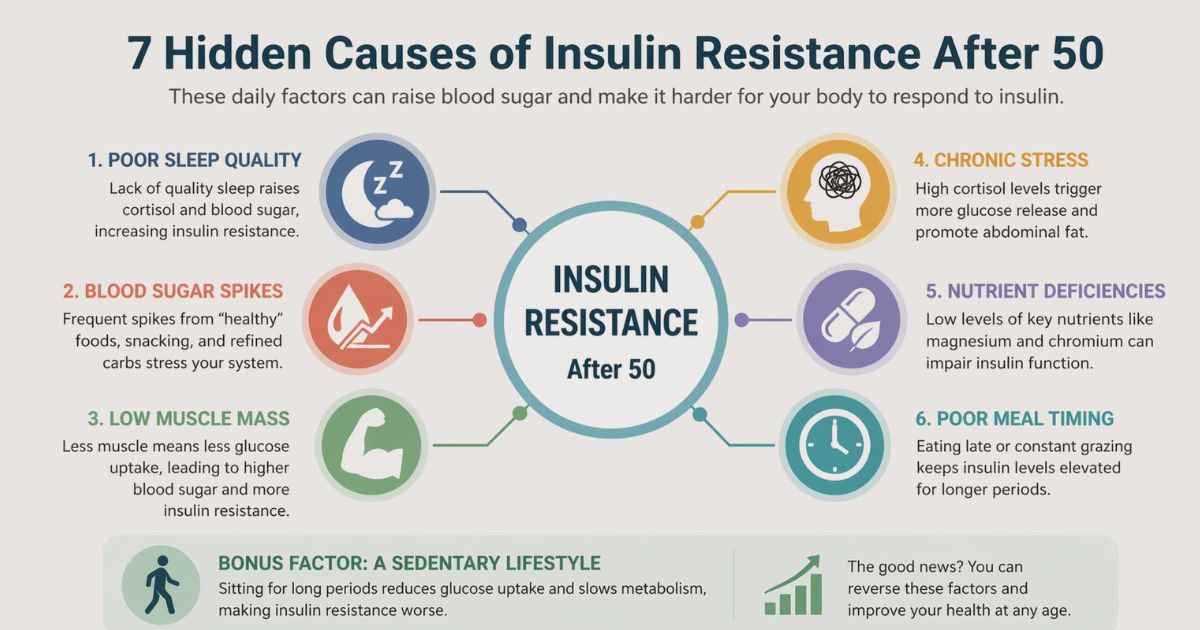
In this article you'll discover the seven most common hidden causes:
- Poor sleep quality
- Blood sugar spikes from everyday foods
- Loss of muscle mass
- Chronic stress and high cortisol
- Nutrient deficiencies
- Poor meal timing
- A sedentary lifestyle
The good news is that many of these factors can be improved with simple, consistent lifestyle changes, helping your body become more responsive to insulin over time.

Why Insulin Resistance Develops More Easily After 50
As we get older, several natural changes occur in the body that can make insulin resistance more likely—even if your lifestyle hasn't changed dramatically.
These include:
- Muscle mass gradually declines
- Hormones begin to shift
- Metabolism becomes less flexible
Together, these changes make it easier for blood sugar levels to rise and harder for your cells to respond effectively to insulin.
Continue Learning: Why Insulin Resistance Becomes More Common After 50 (And What You Can Do About It)
Hidden Cause #1 – Poor Sleep Quality
Sleep plays a much bigger role in blood sugar control than many people realize. Even one night of poor-quality sleep can affect how your body responds to insulin the following day.
Poor sleep can:
- Increase insulin resistance
- Raise cortisol (the body's main stress hormone)
- Lead to higher fasting blood sugar the next morning
Over time, consistently poor sleep can make it more difficult to maintain healthy blood sugar levels and may contribute to ongoing metabolic problems.
Continue Learning: How Sleep Affects Insulin Resistance After 50 (And How to Fix It Naturally)
Hidden Cause #2 – Blood Sugar Spikes From "Healthy" Foods
Many people believe they're eating well—but still experience unexpected spikes in blood sugar.
Even nutritious foods can raise blood sugar when eaten in large portions or without enough protein, healthy fats, or fiber to slow digestion.
Common triggers include:
- Large bowls of oats
- Fruit-heavy smoothies
- Frequent snacking
- Refined "healthy" packaged foods
Over time, repeated blood sugar spikes can make your body less responsive to insulin, gradually increasing insulin resistance.
Continue Learning:
Hidden Cause #3 – Loss of Muscle Mass
Muscle plays a vital role in blood sugar control because it acts like a sponge, absorbing glucose from the bloodstream after you eat.
After 50, muscle loss (known as sarcopenia) naturally accelerates—especially without regular resistance exercise.
As muscle mass declines:
- Less glucose is taken up by your muscles
- More glucose remains in the bloodstream
- Your body needs to produce more insulin
This is one reason why maintaining muscle becomes increasingly important as we age.
Even two or three short resistance-training sessions each week can help preserve muscle, improve insulin sensitivity, and support healthier blood sugar levels.
Continue Learning: The Best Daily Routine to Improve Insulin Resistance After 50
Hidden Cause #4 – Chronic Stress and Cortisol
Stress doesn't just affect your mood—it also has a direct impact on your blood sugar.
When you're under ongoing stress, your body releases more cortisol, often called the stress hormone. While helpful in short bursts, constantly elevated cortisol can make it harder for your cells to respond to insulin.
Over time, higher cortisol levels can:
- Trigger the liver to release more glucose into the bloodstream
- Raise blood sugar levels
- Encourage fat storage, especially around the abdomen
This creates a cycle where chronic stress and insulin resistance reinforce each other, making it harder to maintain healthy blood sugar levels.
Continue Learning: The Real Reason Belly Fat Becomes More Stubborn After 50 (And What You Can Do About It)
Hidden Cause #5 – Nutrient Deficiencies
Certain nutrients help your body respond to insulin and regulate blood sugar effectively. When these nutrients are consistently low, insulin sensitivity can gradually decline.
Two of the most important nutrients are:
- Magnesium
- Chromium
Magnesium supports hundreds of enzyme reactions involved in energy production and glucose metabolism, while chromium appears to support insulin signaling in some people.
Although nutrient deficiencies alone rarely cause insulin resistance, they can make blood sugar control more difficult—especially when combined with other lifestyle factors.
Continue Learning: The Missing Link in Insulin Resistance After 50: Why Magnesium Matters More Than You Think
Hidden Cause #6 – Poor Meal Timing
When you eat can be just as important as what you eat.
Common issues include:
- Eating late at night
- Constant grazing throughout the day
- Not allowing blood sugar to return to baseline
This keeps insulin levels elevated for long periods, making the body less responsive over time.
Continue Learning: How to Lower Fasting Blood Sugar Naturally After 50 (Without Medication First)
Hidden Cause #7 – A Sedentary Lifestyle
Long periods of sitting reduce your muscles' ability to absorb glucose from the bloodstream—even if you exercise regularly.
In fact, spending most of the day inactive can still:
- Increase insulin resistance
- Slow metabolism
- Reduce muscle efficiency
The good news is that small amounts of movement throughout the day can make a meaningful difference.
Even standing up every 30–60 minutes, taking a short walk, or doing a few heel raises can help activate your muscles, improve glucose uptake, and support healthier blood sugar levels.
Continue Learning: The Best Daily Routine to Improve Insulin Resistance After 50
How These Causes Work Together (The Real Insight)
Most people don't develop insulin resistance because of a single cause. Instead, it usually develops gradually as several age-related changes and lifestyle habits begin working together.
These can include:
- Poor sleep
- Frequent blood sugar spikes
- Loss of muscle mass
- Chronic stress
- Nutrient deficiencies
- Physical inactivity
Each factor can make the others worse over time. For example, poor sleep can increase stress hormones, stress can raise blood sugar, and long periods of inactivity reduce your muscles' ability to remove glucose from the bloodstream.
The good news is that you don't have to fix everything at once. Improving several small habits together often produces much better results than trying to perfect just one.
The Good News – You Can Reverse This
Even though insulin resistance becomes more common after 50, it is not an inevitable part of aging. In many cases, it can be improved—and often even reversed—with consistent lifestyle changes.
Small, sustainable habits can lead to meaningful improvements in:
- More stable blood sugar
- Better energy levels
- Healthier weight management
- Overall metabolic health
The key is to focus on steady progress rather than trying to change everything at once.
Continue Learning: How to Reverse Insulin Resistance Naturally After 50
The Bottom Line
Understanding what causes insulin resistance is the first step toward taking control of your metabolic health.
The encouraging news is that insulin resistance rarely develops because of just one factor—and improving it doesn't require a perfect diet or an extreme lifestyle overhaul.
By addressing key drivers such as sleep, movement, nutrition, stress management, and daily habits, you can gradually improve your body's response to insulin and support healthier blood sugar levels over time.
Medical Disclaimer: This article is for educational purposes only and is not intended as medical advice. Always consult your qualified healthcare provider before making significant changes to your diet, supplements, lifestyle, or treatment plan.
Frequently Asked Questions
What is the main cause of insulin resistance after 50?
Insulin resistance after 50 is rarely caused by one single factor. It usually develops gradually as several influences work together, including muscle loss, poor sleep, chronic stress, frequent blood sugar spikes, inactivity, nutrient deficiencies, and meal timing.
Can healthy foods still cause blood sugar spikes?
Yes. Nutritious foods can still raise blood sugar when portions are large or when meals contain too little protein, healthy fat, or fiber. Fruit-heavy smoothies, oversized bowls of oats, frequent snacks, and some refined “healthy” packaged foods can all contribute to unexpected spikes.
How does losing muscle affect insulin resistance?
Muscle helps remove glucose from the bloodstream and use it for energy. As muscle mass declines, less glucose is taken up by your muscles, more remains in circulation, and your body can need to produce more insulin. Regular resistance exercise can help preserve muscle and improve insulin sensitivity.
Can poor sleep raise blood sugar?
Yes. Poor sleep can reduce insulin sensitivity, raise cortisol, and contribute to higher fasting blood sugar the following morning. When poor sleep becomes ongoing, it can make blood sugar regulation more difficult over time.
Does sitting too much matter if I exercise regularly?
Yes. Regular exercise is important, but long periods of uninterrupted sitting can still reduce your muscles’ ability to absorb glucose. Standing up every 30–60 minutes, taking a short walk, or doing a few heel raises can help activate your muscles throughout the day.
Can insulin resistance after 50 be improved?
In many cases, insulin sensitivity can improve through consistent lifestyle changes. Better sleep, regular movement, resistance exercise, balanced meals, stress management, and less frequent grazing can all support healthier blood sugar control. You do not need to change everything at once—steady progress matters more than perfection.
References
DeFronzo RA. (2004). Pathogenesis of type 2 diabetes mellitus
Shulman GI. (2000). Cellular mechanisms of insulin resistance
Spiegel K. et al. (2005). Sleep loss and metabolic function
Barbagallo M & Dominguez LJ. (2015). Magnesium and insulin sensitivity
Continue Learning
Why Insulin Resistance Becomes More Common After 50 (And What You Can Do About It)
Learn why aging increases insulin resistance and discover practical ways to slow or reverse the process.
How to Reverse Insulin Resistance Naturally After 50
A step-by-step guide to improving insulin sensitivity through sustainable lifestyle habits.
The Best Daily Routine to Improve Insulin Resistance After 50
Discover a simple daily routine that supports healthier blood sugar from morning to night.
How Sleep Affects Insulin Resistance After 50 (And How to Fix It Naturally)
Learn why sleep quality plays such an important role in blood sugar control.
Why Blood Sugar Spikes After 50 (Even If You Eat Healthy Foods)
Understand why seemingly healthy meals can still raise blood sugar—and what to do about it.